Skip to content
  • Visit
    • TOURS
    • Accessibility
    • HOURS & LOCATION
    • BECOME A MEMBER
    • ADMISSION
    • GIFT SHOP
  • Exhibits
    • The German Immigrant Experience
    • Play On! German Immigrants and the Quad Cities’ Musical Legacy
    • Shaped By Immigrants: Celebrating 250 Years of the United States
    • Past Exhibitions
  • Learn
    • GAHC From Home
    • Internships
    • Volunteer
    • Resources
    • Translation Services
    • Book Discussions​
    • Travel
    • Stammtisch
  • Events
  • About
    • About Us
    • Collections
    • DEAI Statement
    • Staff
    • Employment Opportunities
    • Newsletter
    • Contact Us
    • Media Kit
  • Private Events
  • Donate
  • Visit
    • TOURS
    • Accessibility
    • HOURS & LOCATION
    • BECOME A MEMBER
    • ADMISSION
    • GIFT SHOP
  • Exhibits
    • The German Immigrant Experience
    • Play On! German Immigrants and the Quad Cities’ Musical Legacy
    • Shaped By Immigrants: Celebrating 250 Years of the United States
    • Past Exhibitions
  • Learn
    • GAHC From Home
    • Internships
    • Volunteer
    • Resources
    • Translation Services
    • Book Discussions​
    • Travel
    • Stammtisch
  • Events
  • About
    • About Us
    • Collections
    • DEAI Statement
    • Staff
    • Employment Opportunities
    • Newsletter
    • Contact Us
    • Media Kit
  • Private Events
  • Donate

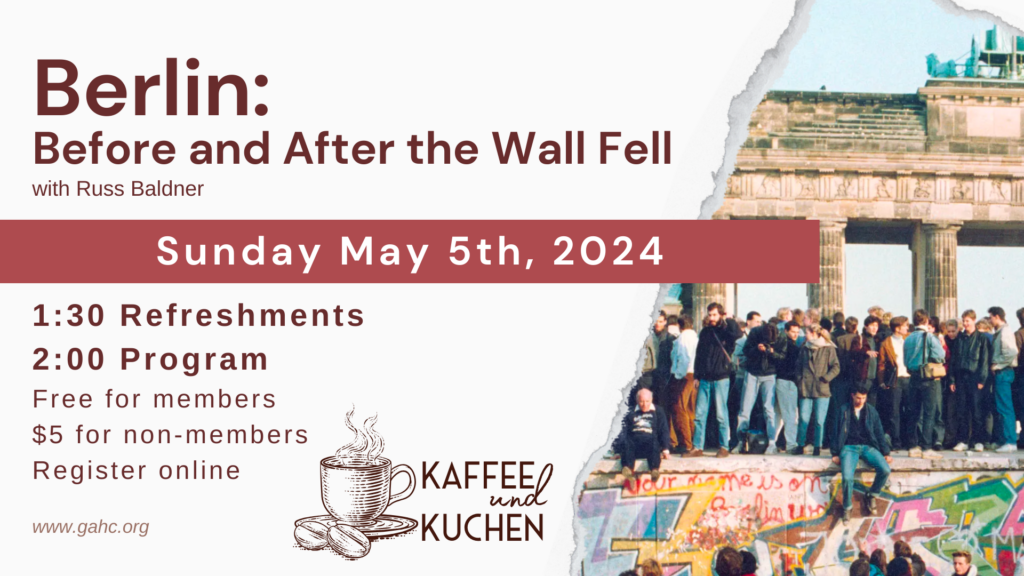
Kaffee und Kuchen

May 5, 2024 |
 1:30 pm -
 3:00 pm
$0-5

Register Here

Learn about the effects of the wall in Berlin

Beginning with the context of post-World War II Germany and the Cold War, the richly illustrated presentation features historical interpretation and photos of Berlin and the infamous Berlin Wall taken by the author in 1969, eight years after the wall was raised, juxtaposed with many of the same contrasting locations today. Also featured are the iconic Kaiser Wilhelm Gedächtniskirche (Emperor William Memorial Church), including Sunday morning Gottesdienst (divine worship); the historic and beautifully restored Reichstag national capitol building, including a dramatic ascent of its spectacular, new, sparkling glass dome; and the classic Brandenburger Tor (Brandenburg Gate), a historic and prominent symbol of Berlin. Close by and on a stroll along Unter den Linden (Under the Linden Trees), Berlin’s Main Street, are sober memorials and poignant reminders of the Murdered Jews of Europe, the Nazi-era burning of books, and the Victims of War and Dictatorship. Concluding the walk across the heart of the city are Museum Island, the opulent Berliner Dom (cathedral), the soaring Fernsehturm (TV tower) and view of the city from more than 650 feet above it, and a perfect-day cruise on the River Spree. Also included are nuggets of Berliner wit and a little light-hearted fare, both historical and current. The presentation closes on a reflective note with historical ironies and a 30th Anniversary retrospective look at the dramatic events which led to the Fall of the Wall in early November 1989, and photographs and prophetic words—spoken five days after the erection of the wall—which require no comment.

Before or after the program, guests are invited to view our exhibition, Breaking Barriers: Walls Throughout History on our first floor gallery. This is the last day to see this exhibition .

1:30 coffee and cake
2:00 program

FREE for members, $5 for non-members

This event is in-person only.

712 W 2nd St. Davenport, Iowa 52802


Presenter Bio
As a youth, Russell Baldner’s early fascination with the German language and history led to B.A. and M.A. degrees in History and undergraduate and graduate study in German and Archaeology. On his first visit to Germany, the presenter lived in his great-great-grandfather’s birthplace. Baldner specializes in the history of Germany, including the Early and High Middle Ages, the Protestant Reformation and Lutheranism, and 19 th – and 20 th -century Europe. A closely related specialty is the deciphering and translating of historical documents drafted in Kurrentschrift, an archaic form of German cursive script in which few are proficient, also genealogy, ethnic German history, and prehistoric Native American archaeology. By profession an educator, Russell formerly taught German, history and anthropology. His recent publications include nineteenth-century German Lutheran historical and archaic German cursive manuscript studies, a four-part research series on the Late Prehistoric–Early Historic petroglyphs and pictographs of northeast Iowa, and “Diversity in Faith,” a three-part Introduction to the Reformation and Protestantism.

In September 2022, Russell and wife Cathryn hosted “Medieval to Modern Hearts of Germany,” a two-week group tour in northeastern Germany proposed, named, and largely designed by Russ in conjunction with and sponsored by the University of Northern Iowa, his alma mater. Included were pre-departure orientations by Russell focusing on Germany’s history, language, and social-cultural landscape, also historical lectures and interpretive commentaries while on tour, including an interpretive performance by Cathryn on Katharina von Bora, wife of Martin Luther, and a renewed and welcome opportunity for Russ to converse daily in the language of his heritage.

A frequent public speaker, Russell presents on a wide range of historical, linguistic, and archaeological subjects. In 2019, he was invited and first had the great pleasure of joining staff and guests and speaking in person at the German American Heritage Center. Following several subsequent virtual presentations during and following the pandemic, Russ welcomes the current invitation to present and looks eagerly forward to joining and meeting, once again in person, the always gracious staff and guests of the German American Heritage Center.

  • Add to Google Calendar
  • Add to iCalendar
ON INSTAGRAM
  • Follow Us!

German American Heritage Center and Museum

germanamericanheritagecenter

1,407 1,787

Museum exploring the German immigrant experience and history of Davenport and Iowa!

Open
In 1994, a few Quad Cities residents looked at an abandoned building and saw something others didn’t: a place full of stories worth saving. Because of them, this space became a museum, a gathering place, and a home for shared history.

After 15+ years of work and countless volunteer hours, they saved it. They built a place for stories, culture, and community. Last year alone, we connected with over 3,000 students, families, and community members through programs, events, and celebrations.

This space exists because people believed it mattered and showed up.
Help us keep it going.

Every gift helps keep this space open, active, and rooted in community. Give through Birdies for Charity by July 1st to maximize your impact.

You can give online today at https://birdiesforcharity.com/donate?charity=1002# 
You can also fill out a pledge card at the museum or send a check to Birdies for Charity with Bird #1002.

In 1994, a few Quad Cities residents looked at an abandoned building and saw something others didn’t: a place full of stories worth saving. Because of them, this space became a museum, a gathering place, and a home for shared history.

After 15+ years of work and countless volunteer hours, they saved it. They built a place for stories, culture, and community. Last year alone, we connected with over 3,000 students, families, and community members through programs, events, and celebrations.

This space exists because people believed it mattered and showed up.
Help us keep it going.

Every gift helps keep this space open, active, and rooted in community. Give through Birdies for Charity by July 1st to maximize your impact.

You can give online today at https://birdiesforcharity.com/donate?charity=1002#
You can also fill out a pledge card at the museum or send a check to Birdies for Charity with Bird #1002.
…

Open
🍻 Need a Father's Day Gift? 

We have unique items for Father's Day if you need a last-minute gift. Check out our selection of German beer, root beer, pickles, sauerkraut, Boetje's Mustard, books, and more. All of our sales are tax-free! Members get 10% off on all gift shop sales.

You can also gift a membership to the museum for those dads that "don't want anything." Give the gift of history and enjoy one of our Kaffee und Kuchen programs or a museum visit anytime with a membership. 
➡️ https://gahc.org/become-a-member/

🍻 Need a Father`s Day Gift?

We have unique items for Father`s Day if you need a last-minute gift. Check out our selection of German beer, root beer, pickles, sauerkraut, Boetje`s Mustard, books, and more. All of our sales are tax-free! Members get 10% off on all gift shop sales.

You can also gift a membership to the museum for those dads that "don`t want anything." Give the gift of history and enjoy one of our Kaffee und Kuchen programs or a museum visit anytime with a membership.
➡️ https://gahc.org/become-a-member/
…

Open
Deutschland to Davenport Part 2
.
.
These are a just a couple examples of some of the framed wall pieces we have in our collection. Perforated paper needlework was popular during the Victorian period (1837-1901). Punched paper was used for many things, but the most common were the motto designs, consisting of biblical sayings, greetings, popular song titles etc. 
.
.
Thanks to our intern, Bella, for researching and making these stories come to life!

Deutschland to Davenport Part 2
.
.
These are a just a couple examples of some of the framed wall pieces we have in our collection. Perforated paper needlework was popular during the Victorian period (1837-1901). Punched paper was used for many things, but the most common were the motto designs, consisting of biblical sayings, greetings, popular song titles etc.
.
.
Thanks to our intern, Bella, for researching and making these stories come to life!
…

Open
For #PrideMonth, we are sharing important stories of LGBTQ+ history in Germany.

In 1920s Berlin, the Eldorado nightclub stood as one of the most visible and vibrant queer spaces in the world. During the Weimar Republic, Berlin was home to an estimated 170 LGBTQ+ venues. Within these spaces, people found something rare for the time: the ability to gather openly, build community, and express themselves with joy and authenticity. The Eldorado was especially well known for its drag performances and lively atmosphere, drawing both locals and curious tourists.

But this visibility existed alongside risk. Laws like Paragraph 175 still criminalized same-sex relationships between men, and gender nonconformity could lead to arrest. Queer spaces like the Eldorado were tolerated, but often contained and monitored. Even so, they offered something powerful: a place to be seen.

That visibility is exactly what made the Eldorado significant—and vulnerable.

In 1933, shortly after the Nazis came to power, the club was shut down. The building was quickly transformed into a headquarters for the SA, the Nazi paramilitary. In a stark and deliberate image of control, photographs show the once-celebrated nightclub covered in swastikas and Nazi propaganda. A space of joy, community, and self-expression was turned into a symbol of fear and oppression almost overnight.

The story of the Eldorado is a reminder of how quickly spaces of belonging can be erased—and why they matter. For a time, it offered a glimpse of what was possible when queer people could live openly. Its loss underscores the devastating impact of Nazi persecution, but also the importance of visibility, community, and resistance.

Learn more about Eldorado Nightclub here: https://www.ilholocaustmuseum.org/celebrating-queer-joy-in-1920s-berlin/
Exterior photos show Eldorado Nightclub in 1932 and 1933.

For #PrideMonth, we are sharing important stories of LGBTQ+ history in Germany.

In 1920s Berlin, the Eldorado nightclub stood as one of the most visible and vibrant queer spaces in the world. During the Weimar Republic, Berlin was home to an estimated 170 LGBTQ+ venues. Within these spaces, people found something rare for the time: the ability to gather openly, build community, and express themselves with joy and authenticity. The Eldorado was especially well known for its drag performances and lively atmosphere, drawing both locals and curious tourists.

But this visibility existed alongside risk. Laws like Paragraph 175 still criminalized same-sex relationships between men, and gender nonconformity could lead to arrest. Queer spaces like the Eldorado were tolerated, but often contained and monitored. Even so, they offered something powerful: a place to be seen.

That visibility is exactly what made the Eldorado significant—and vulnerable.

In 1933, shortly after the Nazis came to power, the club was shut down. The building was quickly transformed into a headquarters for the SA, the Nazi paramilitary. In a stark and deliberate image of control, photographs show the once-celebrated nightclub covered in swastikas and Nazi propaganda. A space of joy, community, and self-expression was turned into a symbol of fear and oppression almost overnight.

The story of the Eldorado is a reminder of how quickly spaces of belonging can be erased—and why they matter. For a time, it offered a glimpse of what was possible when queer people could live openly. Its loss underscores the devastating impact of Nazi persecution, but also the importance of visibility, community, and resistance.

Learn more about Eldorado Nightclub here: https://www.ilholocaustmuseum.org/celebrating-queer-joy-in-1920s-berlin/
Exterior photos show Eldorado Nightclub in 1932 and 1933.
…

Open
🏛️ This week is #IowaMuseumWeek, which highlights the people, stories, objects, and connections that make museums vital to Iowa’s culture and future.

🇺🇸 Engage with your local museums this summer and check out all of their offerings. This summer, the German American Heritage Center and Museum is excited to bring lots of programs and exhibitions to Davenport. Celebrate America's 250th this year by engaging with history and learning something new:

Sunday June 14th: Kaffee und Kuchen: Germans in the Military from Von Steuben through WWII 
Sunday June 28th: Kaffee und Kuchen: Hamburg on Mississippi: Davenport's Germans and the Musical Mecca of the West 
Sunday July 12th: Best of the Wurst 2026 
Sunday July 19th: Kaffee und Kuchen: Davenport Civil Rights Movement 
Summer Architectural Walking Tours on Select Saturdays 

🎟️ FREE ADMISSION in July sponsored by Cal and Jill Werner

Current Exhibitions:
📜 Shaped by Immigrants: Celebrating 250 Years of the United States
🪗 Play On! German Immigrants and the Quad Cities' Musical Legacy
Upcoming Exhibitions: 
✊ Davenport Civil Rights Movement: A Traveling Exhibit from the Putnam Museum 
Iowa Museum Association

🏛️ This week is #IowaMuseumWeek, which highlights the people, stories, objects, and connections that make museums vital to Iowa’s culture and future.

🇺🇸 Engage with your local museums this summer and check out all of their offerings. This summer, the German American Heritage Center and Museum is excited to bring lots of programs and exhibitions to Davenport. Celebrate America`s 250th this year by engaging with history and learning something new:

Sunday June 14th: Kaffee und Kuchen: Germans in the Military from Von Steuben through WWII
Sunday June 28th: Kaffee und Kuchen: Hamburg on Mississippi: Davenport`s Germans and the Musical Mecca of the West
Sunday July 12th: Best of the Wurst 2026
Sunday July 19th: Kaffee und Kuchen: Davenport Civil Rights Movement
Summer Architectural Walking Tours on Select Saturdays

🎟️ FREE ADMISSION in July sponsored by Cal and Jill Werner

Current Exhibitions:
📜 Shaped by Immigrants: Celebrating 250 Years of the United States
🪗 Play On! German Immigrants and the Quad Cities` Musical Legacy
Upcoming Exhibitions:
✊ Davenport Civil Rights Movement: A Traveling Exhibit from the Putnam Museum
Iowa Museum Association
…

Open
Deutschland to Davenport Part 1: Ernst Otto
.
Learn more about the life of Ernst Otto, a German immigrant who came to Davenport. You can learn more about music history in Davenport in our current exhibition, "Play On! German Immigrants and the Quad Cities' Musical Legacy" on the 3rd floor through August 2nd.
.
#history #museum #IowaMuseumWeek #german #music #quadcities #qcthatswhere

Deutschland to Davenport Part 1: Ernst Otto
.
Learn more about the life of Ernst Otto, a German immigrant who came to Davenport. You can learn more about music history in Davenport in our current exhibition, "Play On! German Immigrants and the Quad Cities` Musical Legacy" on the 3rd floor through August 2nd.
.
#history #museum #IowaMuseumWeek #german #music #quadcities #qcthatswhere
…

Open
For #PrideMonth, we are sharing the stories of LGBTQ+ individuals from history. 

Gertrude Sandmann (1893–1981) was a Berlin artist who refused to let persecution erase her life or her work.

As a Jewish woman and a lesbian under Nazi rule, Sandmann faced constant danger. She was banned from exhibiting her art, pushed out of public life, and stripped of her professional identity. But she did not disappear.

Sandmann had built her artistic career at a time when women were often excluded from formal training. She studied at the Berlin Association of Women Artists and later worked under Käthe Kollwitz, who remained an important mentor and friend.
In her personal life, Sandmann also challenged expectations. She knew she was a lesbian from a young age. After a brief marriage to a man due to social pressure, she developed a lasting partnership with Hedwig Koslowski in 1927. Their relationship would later become a lifeline.

By the early 1940s, the threat of deportation was real and widely understood as a death sentence. In 1942, Sandmann made a desperate and courageous decision to stage her own death. Leaving behind a suicide note and her belongings, she went into hiding in Berlin.

For more than two years, Sandmann lived in secret. She moved between hiding places, relying on a small network of trusted friends, including Koslowski, who risked her own safety to help her survive. Cut off from her art and community, Sandmann endured isolation, hunger, and fear: but she survived.

After the war, Sandmann returned to her work. Despite lasting health problems from her time in hiding, she rebuilt her artistic career, exhibited her work, and even held a solo exhibition in 1974. She also became an advocate for LGBTQ+ rights in postwar Germany. Her life reminds us that even in the darkest times, people find ways to endure hardship and remain inspired to create.

Learn more about her life here: https://www.deutsche-digitale-bibliothek.de/content/blog/kulturerbe-erzaehlt-die-kuenstlerin-gertrude-sandmann?lang=en 

Artwork - Berlinische Galerie:
Grüne Schneeballen, 1949 
Kauerndes Mädchen mit Schatten, 1940

For #PrideMonth, we are sharing the stories of LGBTQ+ individuals from history.

Gertrude Sandmann (1893–1981) was a Berlin artist who refused to let persecution erase her life or her work.

As a Jewish woman and a lesbian under Nazi rule, Sandmann faced constant danger. She was banned from exhibiting her art, pushed out of public life, and stripped of her professional identity. But she did not disappear.

Sandmann had built her artistic career at a time when women were often excluded from formal training. She studied at the Berlin Association of Women Artists and later worked under Käthe Kollwitz, who remained an important mentor and friend.
In her personal life, Sandmann also challenged expectations. She knew she was a lesbian from a young age. After a brief marriage to a man due to social pressure, she developed a lasting partnership with Hedwig Koslowski in 1927. Their relationship would later become a lifeline.

By the early 1940s, the threat of deportation was real and widely understood as a death sentence. In 1942, Sandmann made a desperate and courageous decision to stage her own death. Leaving behind a suicide note and her belongings, she went into hiding in Berlin.

For more than two years, Sandmann lived in secret. She moved between hiding places, relying on a small network of trusted friends, including Koslowski, who risked her own safety to help her survive. Cut off from her art and community, Sandmann endured isolation, hunger, and fear: but she survived.

After the war, Sandmann returned to her work. Despite lasting health problems from her time in hiding, she rebuilt her artistic career, exhibited her work, and even held a solo exhibition in 1974. She also became an advocate for LGBTQ+ rights in postwar Germany. Her life reminds us that even in the darkest times, people find ways to endure hardship and remain inspired to create.

Learn more about her life here: https://www.deutsche-digitale-bibliothek.de/content/blog/kulturerbe-erzaehlt-die-kuenstlerin-gertrude-sandmann?lang=en

Artwork – Berlinische Galerie:
Grüne Schneeballen, 1949
Kauerndes Mädchen mit Schatten, 1940
…

Open
Our newest exhibition, "Shaped by Immigrants: Celebrating 250 Years of the United States," is now on display. We have many artifacts from our collection on display as well as loaned pieces from the @putnammuseum.

This Davenport Turner uniform belonged to Hertha A. (Berg) Vogel-Hildebrand (1906-2004), a life member of the Davenport Central Turner Hall. Her mother was the daughter of German immigrants and was a member of the Davenport Zither Club. Her father immigrated from Schleswig-Holstein and was a Scott County employee for over 25 years. He was also a member of the Turner Singing Society. 

In her childhood years, Hertha spent many enjoyable days at Schuetzen Park in Davenport where her father ran the shooting gallery and her mother was the cook. They were actively involved in many German-American activities that were typical of many immigrant families.

Explore more stories about German immigrants, and other immigrant groups and how they have shaped the United States we know it today.

Our newest exhibition, "Shaped by Immigrants: Celebrating 250 Years of the United States," is now on display. We have many artifacts from our collection on display as well as loaned pieces from the @putnammuseum.

This Davenport Turner uniform belonged to Hertha A. (Berg) Vogel-Hildebrand (1906-2004), a life member of the Davenport Central Turner Hall. Her mother was the daughter of German immigrants and was a member of the Davenport Zither Club. Her father immigrated from Schleswig-Holstein and was a Scott County employee for over 25 years. He was also a member of the Turner Singing Society.

In her childhood years, Hertha spent many enjoyable days at Schuetzen Park in Davenport where her father ran the shooting gallery and her mother was the cook. They were actively involved in many German-American activities that were typical of many immigrant families.

Explore more stories about German immigrants, and other immigrant groups and how they have shaped the United States we know it today.
…

VISIT US

German American Heritage Center & Museum
712 W 2nd St.
Davenport, IA 52802

HOURS

Tuesdays – Saturdays open 10 am – 4 pm
Sundays open 12 – 4 pm
Closed Mondays

NEWSLETTER

This field is for validation purposes and should be left unchanged.
STAY CONNECTED
Instagram Facebook-f Twitter
Sign Up for our Newsletter
German American Heritage Center & Museum
712 W 2nd St.
Davenport, IA 52802
Tuesdays – Saturdays open 10 am – 4 pm
Sundays open 12 – 4 pm
Closed Mondays

Newsletter

Subscribe to get all latest news, updates.

This field is for validation purposes and should be left unchanged.