
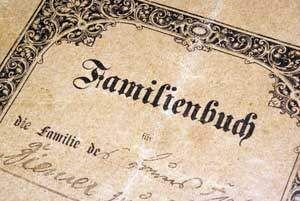
Here at the GAHC+M, our members, visitors, and community continuously provide prior property and remembrances which bolster our collections of genealogy and lineage. In doing so, our team is therefore able to continue supporting our mission of contributing and delivering historically accurate exhibitions, artifact preservation, educational outreach,
and so much more!
The GAHC+M is launching a new Surname Series dedicated to curious or inquiring minds who might have, at one time or another, wondered:
What does my last name mean?
Where is my last name from?
Is my last name a variation of a much older version?
And, of course:
Why might my last name have been changed?
Hopefully (hoffentlich!) through this Surname Series, the GAHC+M can begin answering some, if not all, of these valid questions.
For more information or if you would like to reach out and request more information regarding any of the names, be sure to tune in with us on:
Facebook, Instagram, our website, and by phone!
Common German abbreviations used throughout the writing in the following posts:
USW – und so weiter… (etc., and so on // *und sofort *and so forth)
z.B. – zum Beispiel (for example, similar to the English/Latin i.e. or e.g.)
AI INTEGRITY DISCLAIMER:
NO AI WAS CONSULTED FOR OR DURING THE RESEARCH
AND INFORMATION COMPILING THE PROCESS.
While AI often utilizes bullet points for succinct compiled data and better structure/organize prompts, and while the surnames you see here use similar structure, it should be addressed that ABSOLUTELY NO AI was utilized. Researching, organizing said research, and writing have the bullet point appearance, but this is simply for better/easier viewer/readership. ALL WORK AND ERRORS ARE HUMAN.
Sincerely,
a tired but motivated intern.
COPYRIGHT DISCLAIMER:
This site contains copyrighted material the use of which has not always been authorized by the copyright owner.
Such material is made available in an effort to advance understanding of the country or topic discussed in the article. This constitutes ‘fair use’ of any such copyrighted material as provided for in section 107 of the US Copyright Law. In accordance with Title 17 U.S.C. Section 107, the material on this site is distributed without profit. If you wish to use copyrighted material from this site for purposes of your own that go beyond ‘fair use’, you must obtain permission from the copyright owner. If you are the copyright owner and would like this content removed from gahc.org, please contact [email protected].
Where do German surnames come from?
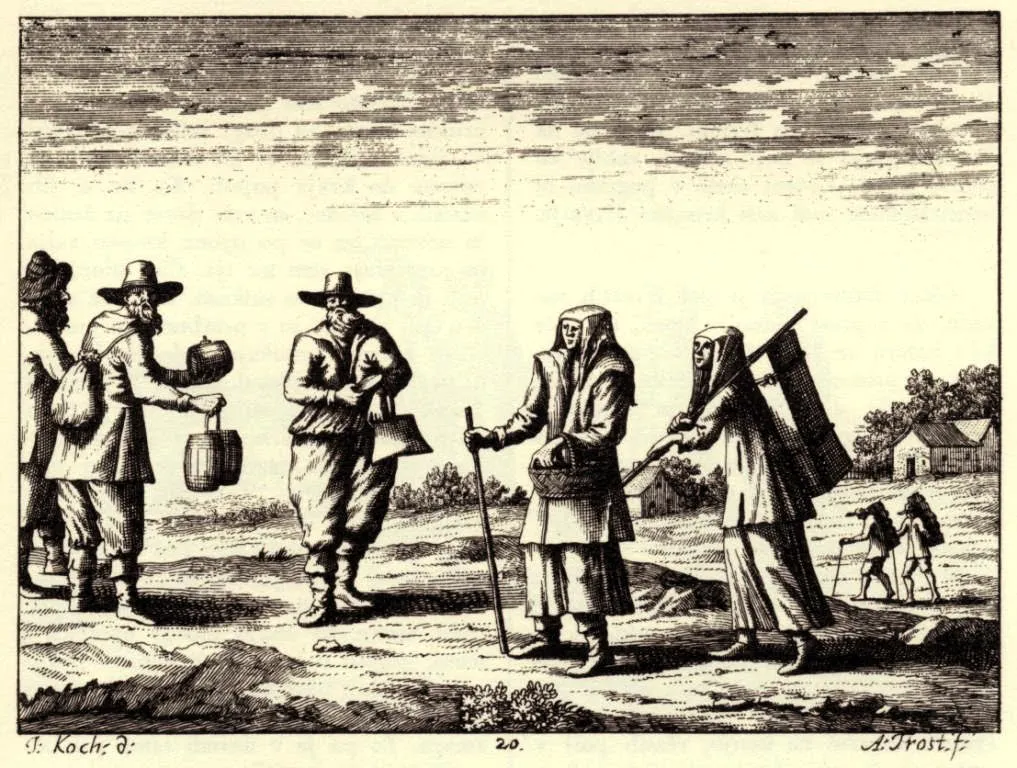
Image Description: 17th Century Copper Engraving of Common European Village Folk (Slovenia) going about their work and lives.
Early Modern Period, 1689. Illustrated by Janez Vajkard Valvasor.
Ref. https://commons.wikimedia.org/wiki/File:Ko%C4%8Devci-Valvasor.jpg
Many German surnames today have roots in the Middle Ages (Mittlealter), and date back almost as early as the 900s-1100s!
It is also likely/one can assume titles were used before then as well, but documentation of these surnames becomes evident with the increased frequency of script and writing, meaning anything before then we can only assume or hypothesize, as writing is crucial for historical assumptions to be backed by physical evidence…
Without tax documents, maps, diary entries, graffiti, usw., historians, linguists, and onomasticians have a harder time tracing pure origin points for words/surnames!
As stated in the introduction and definitions of terminology section relating to this Surname Series* it is widely accepted that most German family surnames usually derive from four main categories, such as:
occupation,
a person’s qualities/personality,
where peoples lived/topographic landmarks,
and of course, inheritance, specifically: surnames which are passed down from maternal or paternal relations and mean something along the lines of “son of/daughter of”
Why does the GAHCM care about German surnames?
Here at the GAHCM, we at least want to attempt to do our part in trying to define/demystify these surnames, so that maybe, it might bring about a better sense of connection to one’s ancestry or even broaden the story surrounding a family’s past.
Upon coming to America, many German immigrants either simplified, Americanized/Anglicized, or changed their last names entirely.
This explains part of the reason why so many Americans with German heritage might find various alternate ways to go about spelling their family name, even if all these variants mean about the same thing.
Names weren’t just changed when getting off the boat at Ellis Island though. Throughout the 20th century, primarily in part/due to two devastating world wars, erasure of German heritage happened on the continental home front. Due to these pressures and fears on/about those with German heritage… names were changed, pride in heritage was lost, and assimilation to American life/culture had a fossilized effect.
Of course, it is also highly likely that many German surnames were changed upon coming overseas for easier pronunciation sake too, but whatever the reason… It certainly makes genealogy/surname research an endless endeavor!
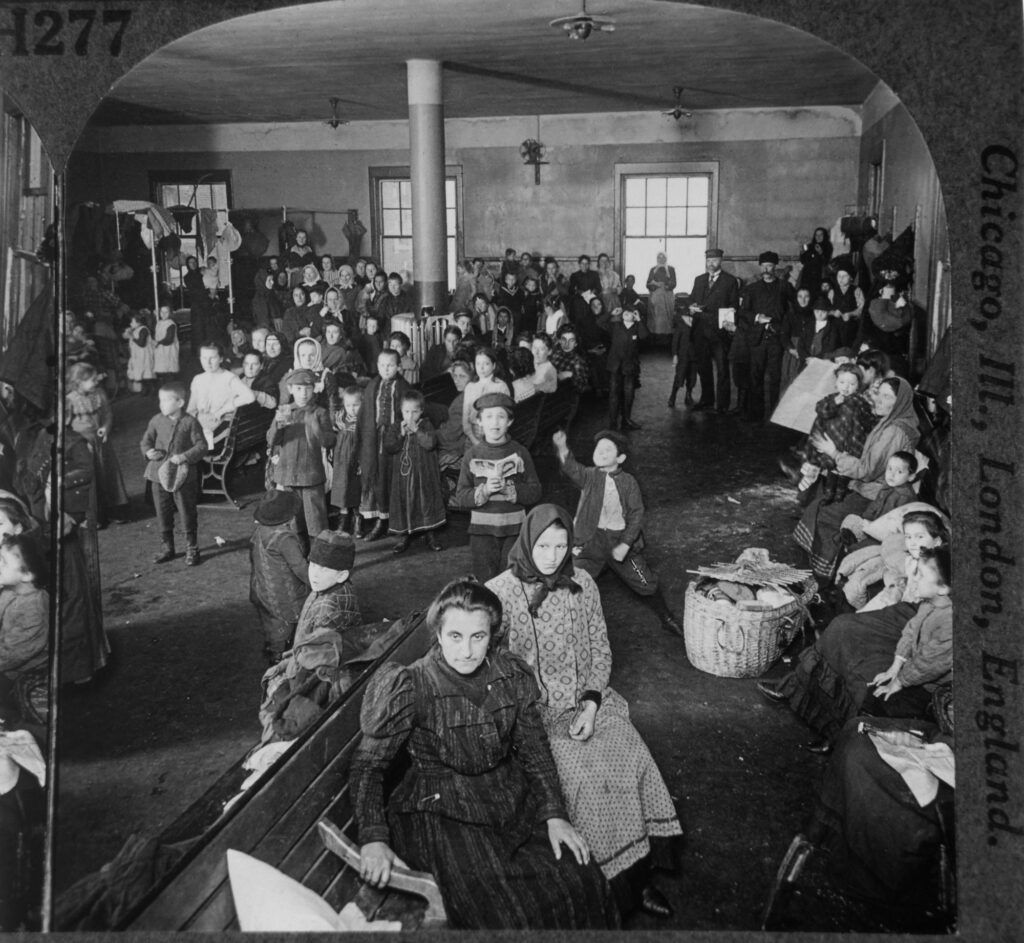
Image Description: B&W Photo of Immigrants at Processing Station, Ellis Island, NYC, early 20th century.
Ref. https://www.deutschland.de/en/usa/us-immigration-americas-german-roots
How can one differentiate whether or not a name is of German origin?
With names that contain vowel clusters, such as ue, ae, and oe these are indications of umlaut usage (z.B. the familiar Ö, Ä, Ü characters)
Similar to the umlaut pronunciation and vowel clusters, names with ei (z.B. klein) are also mostly if not completely of German origin
If you thought the vowel clusters were the only indicators of German origin, think again! Consonant clusters, such as Sch, Neu, Pf, and Str can also indicate German origin.
Examples of names with these consonant clusters might include:
Pfeffer (pepper), Pfizer (well, spring, pond, usw.)
Neumann (newcomer), Neubauer (farmer or possibly someone who just bought new land)
Schmidt/Schmitt/Schmittz (blacksmith)
And of course, end suffixes can often also indicate surnames of German origin.
Examples of names with German end suffixes:
-mann (Neumann)
-lich (Seiberlich)
-berg (Goldberg)
-bruck/brück (Aschenbruck)
Departing thoughts
Stay tuned for bi-weekly updates!
Releases of the Surname Series will NOT follow any specific alphabetic order.
Wieder:
For more information or if you would like to reach out and request more information regarding any of the names, be sure to tune in with us on:
Facebook, Instagram, our website, and by phone!
Contributed by Lily May Jewell, 2026