Skip to content
  • Visit
    • TOURS
    • Accessibility
    • HOURS & LOCATION
    • BECOME A MEMBER
    • ADMISSION
    • GIFT SHOP
  • Exhibits
    • The German Immigrant Experience
    • Play On! German Immigrants and the Quad Cities’ Musical Legacy
    • Violins of Hope Iowa
    • Past Exhibitions
  • Learn
    • GAHC From Home
    • Internships
    • Volunteer
    • Resources
    • Translation Services
    • Book Discussions​
    • Travel
  • Events
  • About
    • About Us
    • Collections
    • DEAI Statement
    • Staff
    • Employment Opportunities
    • Newsletter
    • Contact Us
    • Media Kit
  • Private Events
  • Donate
  • Visit
    • TOURS
    • Accessibility
    • HOURS & LOCATION
    • BECOME A MEMBER
    • ADMISSION
    • GIFT SHOP
  • Exhibits
    • The German Immigrant Experience
    • Play On! German Immigrants and the Quad Cities’ Musical Legacy
    • Violins of Hope Iowa
    • Past Exhibitions
  • Learn
    • GAHC From Home
    • Internships
    • Volunteer
    • Resources
    • Translation Services
    • Book Discussions​
    • Travel
  • Events
  • About
    • About Us
    • Collections
    • DEAI Statement
    • Staff
    • Employment Opportunities
    • Newsletter
    • Contact Us
    • Media Kit
  • Private Events
  • Donate

Kaffee und Kuchen

March 24, 2024 |
 1:30 pm -
 3:00 pm
$0-5

Register Here

Join us to learn about Melchoir Huebinger’s maps of Iowa

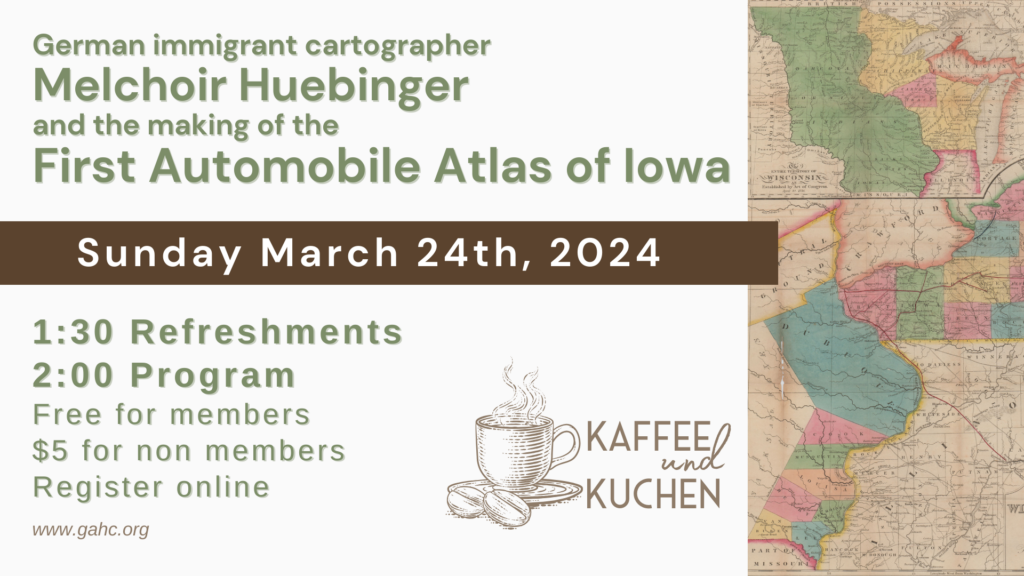
German immigrant cartographer Melchoir Huebinger and the making of the First Automobile Atlas of Iowa

Huebinger arrived as a German immigrant to Davenport in 1880 to work as a surveyor and cartographer for the Army Corps of Engineers in Rock Island. He published his first local atlas of Scott County in 1882, and later produced hundreds of local maps and atlases in his downtown Davenport shop until 1910, when he moved to Des Moines to coordinate the first ever automobile road atlas of Iowa. Mike Flaherty will present a history of Huebinger’s central role in the development of modern maps of Davenport culminating in the production of the first automobile atlas of the state of Iowa in 1912.  Huebinger’s career covered the transition from horse and buggy Victorian maps to modern 20th century automobile map production and is a fascinating look into how maps were made at the turn of the last century.

The presentation will include dozens of local maps, guide books and atlases produced by Huebinger’s companies between 1882 and 1926 from Mr. Flaherty’s collection.

1:30 coffee and cake

2:00 program

Free for GAHC&M members, $5 for non-members.

Register HERE

This event is in-person only.

712 W 2nd St. Davenport, Iowa 52802

Mike Flaherty grew up in Davenport, Iowa and graduated with a B.S. in Geography from the University of Iowa in 1988 and received a M.S in Geographic Information Systems from the University of Redlands in 2005. He started as a geography assistant for the Census Bureau for the 1990 Census, then as a cartographer at the Defense Mapping Agency (DMA) in 1991. DMA has reorganized twice to the National Imagery and Mapping Agency (NIMA) and then to National Geospatial-Intelligence Agency (NGA). In his 32-year career with the federal government he was a geography assistant, cartographer, negative engraver, nautical chart compiler, bathymetrist, lithographic imaging specialist, geospatial intelligence analyst, targeting intelligence analyst, geospatial analyst, program manager, cloud development engineer, staff officer, and photogrammetrist. Mike made maps using the old photographic methods and made the transition to digital cartography and geographic information systems. Fearing being replaced by artificial intelligence mapping applications chose to manage the production of precise satellite imagery for the last third of his career. During his government service, he produced census maps, military topographic maps, city maps, air and naval navigational charts, photomaps, satellite image maps, precise satellite imagery products, elevation models, feature databases, and targeting graphics. After managing NGA’s precise imagery cloud transition for 5 years, Mike retired from Federal service in 2022, and moved back to Davenport. Mr. Flaherty has been collecting maps for over 30 years, and is a member of the Chicago Map Society, Washington Map Society, and Road Map Collectors Association. He is also active in the local Mississippi Valley Region of the Antique Automobile Club of America, and has two brass era automobiles, a 1912 Galloway motor wagon and a 1914 Ford Model T.

  • Add to Google Calendar
  • Add to iCalendar
ON INSTAGRAM
  • Follow Us!

German American Heritage Center and Museum

germanamericanheritagecenter

1,397 1,751

Museum exploring the German immigrant experience and history of Davenport and Iowa!

Open
🚗 🇩🇪 Are you stopping by this Saturday, May 2nd for the annual VW Car Show? Admission to the show and the museum is free and open to the public. Food will be available on-site for purchase. See some of Germany's most iconic cars and visit with the owners to hear about the work they've done on these unique cars.

Grab a brat to eat, check out the classic Beetles, Westfalia vans, and kit cars, then step inside the museum to see our historic building and explore our exhibitions. Make sure to check out the view from the 4th floor!

712 W 2nd St. 
Davenport, Iowa 
Car Show: 10 am - 1 pm
Museum open: 10 am - 4 pm

🚗 🇩🇪 Are you stopping by this Saturday, May 2nd for the annual VW Car Show? Admission to the show and the museum is free and open to the public. Food will be available on-site for purchase. See some of Germany`s most iconic cars and visit with the owners to hear about the work they`ve done on these unique cars.

Grab a brat to eat, check out the classic Beetles, Westfalia vans, and kit cars, then step inside the museum to see our historic building and explore our exhibitions. Make sure to check out the view from the 4th floor!

712 W 2nd St.
Davenport, Iowa
Car Show: 10 am – 1 pm
Museum open: 10 am – 4 pm
…

Open
🧙‍♀️ Walpurgisnacht, celebrated on April 30th, is one of the most intriguing traditions in German cultural history. Often called the “Night of Witches,” it sits at the intersection of folklore, seasonal celebration, and Christian tradition. Long before it was linked to witches and bonfires, the night marked the transition from winter to spring; a time associated with warmth, light, and new growth.

The name comes from Saint Walpurga, an 8th-century abbess and missionary whose feast day falls on May 1. Over time, her name became connected with existing spring observances. Across Europe, people gathered on the eve of May Day to light fires and celebrate the changing season, blending Christian and older folk traditions into a distinct cultural moment.

#Walpurgisnacht is especially rich in symbolism. Bonfires played a central role, both as festive gatherings and as protective rituals believed to ward off evil spirits before the new season began. Folklore also tied the night to stories of witches gathering on mountaintops, adding a darker, mysterious dimension. This blend of seasonal joy and supernatural legend has helped the tradition endure.

Photos: Costumes at a Walpurgisnacht parade.
Crowd on Walpurgisnacht at the Thingstätte on the Heiligenberg in Heidelberg.

🧙‍♀️ Walpurgisnacht, celebrated on April 30th, is one of the most intriguing traditions in German cultural history. Often called the “Night of Witches,” it sits at the intersection of folklore, seasonal celebration, and Christian tradition. Long before it was linked to witches and bonfires, the night marked the transition from winter to spring; a time associated with warmth, light, and new growth.

The name comes from Saint Walpurga, an 8th-century abbess and missionary whose feast day falls on May 1. Over time, her name became connected with existing spring observances. Across Europe, people gathered on the eve of May Day to light fires and celebrate the changing season, blending Christian and older folk traditions into a distinct cultural moment.

#Walpurgisnacht is especially rich in symbolism. Bonfires played a central role, both as festive gatherings and as protective rituals believed to ward off evil spirits before the new season began. Folklore also tied the night to stories of witches gathering on mountaintops, adding a darker, mysterious dimension. This blend of seasonal joy and supernatural legend has helped the tradition endure.

Photos: Costumes at a Walpurgisnacht parade.
Crowd on Walpurgisnacht at the Thingstätte on the Heiligenberg in Heidelberg.
…

Open
Join us on Saturday, May 2nd, 2026 from 10 AM to 1 PM for the annual VW Car Show right in our parking lot! Admission to the show and the museum is free and open to the public. Food will be available on-site for purchase.

Join us for a fun-filled day of classic Beetles, Westfalia vans, kit cars and more! Come and see the history of one of Germany’s most iconic car brands right in our parking lot.

We will feature a special appearance by a replica of Iowa’s first bookmobile, “The Lydia,” named for librarian Lydia Margaret Barrette of Rock Island and Davenport. 

First launched in 1926 by the Iowa Library Association, the “Book Caravan” brought library services to rural communities, stopping at country schools and farm homes. For $50 per week, counties could host the traveling library to build support for local library systems.

Known as “The Lydia,” the bookmobile carried out Barrette’s vision of expanding access to books across Iowa, guided by the slogan: “Three books to every man, woman and child in Iowa.”

Parking at the museum is limited. We encourage visitors to utilize the street parking on 3rd street or surrounding streets. There may be spaces off of 2nd St and Western Ave where the old YMCA used to be.

The German American Heritage Center and Museum will be free and open to the public all day, Saturday May 2nd, 2026.

Join us on Saturday, May 2nd, 2026 from 10 AM to 1 PM for the annual VW Car Show right in our parking lot! Admission to the show and the museum is free and open to the public. Food will be available on-site for purchase.

Join us for a fun-filled day of classic Beetles, Westfalia vans, kit cars and more! Come and see the history of one of Germany’s most iconic car brands right in our parking lot.

We will feature a special appearance by a replica of Iowa’s first bookmobile, “The Lydia,” named for librarian Lydia Margaret Barrette of Rock Island and Davenport.

First launched in 1926 by the Iowa Library Association, the “Book Caravan” brought library services to rural communities, stopping at country schools and farm homes. For $50 per week, counties could host the traveling library to build support for local library systems.

Known as “The Lydia,” the bookmobile carried out Barrette’s vision of expanding access to books across Iowa, guided by the slogan: “Three books to every man, woman and child in Iowa.”

Parking at the museum is limited. We encourage visitors to utilize the street parking on 3rd street or surrounding streets. There may be spaces off of 2nd St and Western Ave where the old YMCA used to be.

The German American Heritage Center and Museum will be free and open to the public all day, Saturday May 2nd, 2026.
…

Open
April 26 is recognized as National Pretzel Day!
 
There is no single story about the invention of the pretzel, as many cultures have adapted it in their own ways. However, the most widely told version centers on an Italian monk who wanted to keep the attention of his pupils. He rolled out dough and crossed the ends to resemble the way the students’ arms were meant to be folded during prayer. Earning the Latin name "Bracellae" which translates to “little arms.”

After the invention of pretzels, their popularity boomed throughout Europe and the Middle Ages. The ingredients, four and water, were cheap and commonly given to the poor as nourishment.

Pretzels have found their way into various stories of accidental invention. Though the invention was invented by an Italian, the pretzel is often associated with Germany, with a specific distinction between a traditional pretzel and German pretzel. The German pretzel originated from the baker of the Munich Royal Cafe in 1839. While preparing to bake pretzels, and brushing them with sugar-water, he accidentally used a sodium hydroxide solution that was used as a cleaner for the bakery equipment. He baked them anyway, and pulled out a crispy brown crusted pretzel with a salty taste.

In addition to these stories, the innovation of hard pretzels originated in about 1600 when a baking apprentice in Pennsylvania fell asleep and overcooked the batch.

In Germany many children are known to wear pretzel necklaces on New Year's Day. Where the phrase “tying the knot” originated from the Swiss tradition of newlyweds breaking a lucky pretzel in the same manner as a wishbone.

Another country of intention is Austria. At Christmas, pretzels were part of tree decorations in the sixteenth century, in addition to this, they believe that the monks were baking pretzels in the basement of their monastery in 1510, when they heard Ottoman Turks tunneling underground. 

Lastly, pretzel lore made its way to America on the Mayflower, where pretzels were reportedly used to trade with Native Americans. The snack remains popular to this day!

Photo: Street types of New York City: Emigrant and pretzel vendor, ca. 1896. Library of Congress.

April 26 is recognized as National Pretzel Day!

There is no single story about the invention of the pretzel, as many cultures have adapted it in their own ways. However, the most widely told version centers on an Italian monk who wanted to keep the attention of his pupils. He rolled out dough and crossed the ends to resemble the way the students’ arms were meant to be folded during prayer. Earning the Latin name "Bracellae" which translates to “little arms.”

After the invention of pretzels, their popularity boomed throughout Europe and the Middle Ages. The ingredients, four and water, were cheap and commonly given to the poor as nourishment.

Pretzels have found their way into various stories of accidental invention. Though the invention was invented by an Italian, the pretzel is often associated with Germany, with a specific distinction between a traditional pretzel and German pretzel. The German pretzel originated from the baker of the Munich Royal Cafe in 1839. While preparing to bake pretzels, and brushing them with sugar-water, he accidentally used a sodium hydroxide solution that was used as a cleaner for the bakery equipment. He baked them anyway, and pulled out a crispy brown crusted pretzel with a salty taste.

In addition to these stories, the innovation of hard pretzels originated in about 1600 when a baking apprentice in Pennsylvania fell asleep and overcooked the batch.

In Germany many children are known to wear pretzel necklaces on New Year`s Day. Where the phrase “tying the knot” originated from the Swiss tradition of newlyweds breaking a lucky pretzel in the same manner as a wishbone.

Another country of intention is Austria. At Christmas, pretzels were part of tree decorations in the sixteenth century, in addition to this, they believe that the monks were baking pretzels in the basement of their monastery in 1510, when they heard Ottoman Turks tunneling underground.

Lastly, pretzel lore made its way to America on the Mayflower, where pretzels were reportedly used to trade with Native Americans. The snack remains popular to this day!

Photo: Street types of New York City: Emigrant and pretzel vendor, ca. 1896. Library of Congress.
…

Open
We were thrilled to welcome Thomas Meinecke to Davenport on Saturday evening for a special program celebrating Bix Beiderbecke and his music. 

Thomas bought his first jazz record in Germany when he was 14 with pocket change. He quickly fell in love with Bix Beiderbecke and his music. This sparked a lifelong interest in American Jazz, music, and Bix's life. He even recounted tearing a page out of a library book in his youth because it had Bix's portrait on it, and he wanted to hang it in his room!

Now a novelist and Radio DJ, his love of music has shaped his career. This spring he is traveling the United States with the Goethe-Institut to promote his books. During a few days off this weekend, Thomas was excited to make a side trip to Davenport to visit Bix's hometown. Thank you @goetheinstitut.chicago for collaborating with us and making this event possible. We are so thrilled to make international connections and bring exciting events here to the museum. Vielen Dank! 🇩🇪 🇺🇸

We were thrilled to welcome Thomas Meinecke to Davenport on Saturday evening for a special program celebrating Bix Beiderbecke and his music.

Thomas bought his first jazz record in Germany when he was 14 with pocket change. He quickly fell in love with Bix Beiderbecke and his music. This sparked a lifelong interest in American Jazz, music, and Bix`s life. He even recounted tearing a page out of a library book in his youth because it had Bix`s portrait on it, and he wanted to hang it in his room!

Now a novelist and Radio DJ, his love of music has shaped his career. This spring he is traveling the United States with the Goethe-Institut to promote his books. During a few days off this weekend, Thomas was excited to make a side trip to Davenport to visit Bix`s hometown. Thank you @goetheinstitut.chicago for collaborating with us and making this event possible. We are so thrilled to make international connections and bring exciting events here to the museum. Vielen Dank! 🇩🇪 🇺🇸
…

Open
What led to the Holocaust’s escalation? Dr. Robinson Yost breaks down the impact of Operation Barbarossa and why it remains a critical moment in history.

Join us for Kaffee und Kuchen on Sunday April 26th. Registration available online or at the door.

What led to the Holocaust’s escalation? Dr. Robinson Yost breaks down the impact of Operation Barbarossa and why it remains a critical moment in history.

Join us for Kaffee und Kuchen on Sunday April 26th. Registration available online or at the door.
…

Open
Have you seen the Violins of Hope yet?

The last day to view our exhibition is Sunday April 26th. Be sure to stop by and see them before they are gone!

Have you seen the Violins of Hope yet?

The last day to view our exhibition is Sunday April 26th. Be sure to stop by and see them before they are gone!
…

Open
Have you seen the Violins of Hope yet? 

The last day to see these incredible instruments is Sunday April 26th. Be sure to see them at the German American Heritage Center and Museum before they're gone!

Have you seen the Violins of Hope yet?

The last day to see these incredible instruments is Sunday April 26th. Be sure to see them at the German American Heritage Center and Museum before they`re gone!
…

VISIT US

German American Heritage Center & Museum
712 W 2nd St.
Davenport, IA 52802

HOURS

Tuesdays – Saturdays open 10 am – 4 pm
Sundays open 12 – 4 pm
Closed Mondays

NEWSLETTER

This field is for validation purposes and should be left unchanged.
STAY CONNECTED
Instagram Facebook-f Twitter
Sign Up for our Newsletter
German American Heritage Center & Museum
712 W 2nd St.
Davenport, IA 52802
Tuesdays – Saturdays open 10 am – 4 pm
Sundays open 12 – 4 pm
Closed Mondays

Newsletter

Subscribe to get all latest news, updates.

This field is for validation purposes and should be left unchanged.