Skip to content
  • Visit
    • TOURS
    • Accessibility
    • HOURS & LOCATION
    • BECOME A MEMBER
    • ADMISSION
    • GIFT SHOP
  • Exhibits
    • The German Immigrant Experience
    • Play On! German Immigrants and the Quad Cities’ Musical Legacy
    • Violins of Hope Iowa
    • Past Exhibitions
  • Learn
    • GAHC From Home
    • Internships
    • Volunteer
    • Resources
    • Translation Services
    • Book Discussions​
    • Travel
  • Events
  • About
    • About Us
    • Collections
    • DEAI Statement
    • Staff
    • Employment Opportunities
    • Newsletter
    • Contact Us
    • Media Kit
  • Private Events
  • Donate
  • Visit
    • TOURS
    • Accessibility
    • HOURS & LOCATION
    • BECOME A MEMBER
    • ADMISSION
    • GIFT SHOP
  • Exhibits
    • The German Immigrant Experience
    • Play On! German Immigrants and the Quad Cities’ Musical Legacy
    • Violins of Hope Iowa
    • Past Exhibitions
  • Learn
    • GAHC From Home
    • Internships
    • Volunteer
    • Resources
    • Translation Services
    • Book Discussions​
    • Travel
  • Events
  • About
    • About Us
    • Collections
    • DEAI Statement
    • Staff
    • Employment Opportunities
    • Newsletter
    • Contact Us
    • Media Kit
  • Private Events
  • Donate

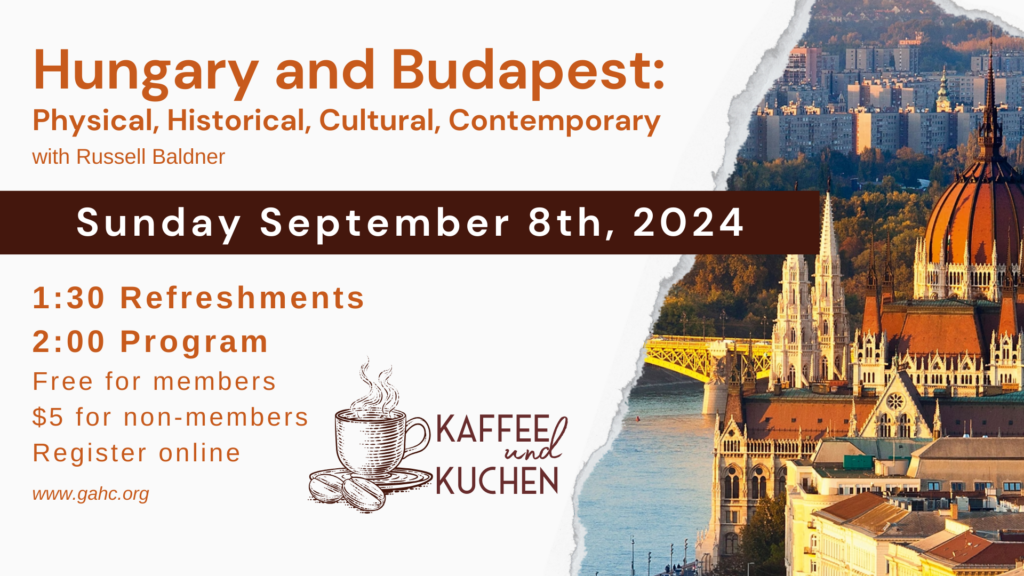
Kaffee und Kuchen

September 8, 2024 |
 1:30 pm -
 3:00 pm
$0-5

Register Here

Join us as we explore the history, cultural heritage, and architectural treasures of Hungary and charming Budapest, the “Pearl of the Danube.”

From the arrival of the Hungarian Magyar tribes in the Carpathian basin of Europe in the 9th century and the establishment of the first Hungarian state to the subsequent conquest of the Hungarian monarchy by the Ottoman Turks, rule by the Austrian Habsburgs, and the rise of fervent Hungarian nationalist aspirations in the 19th century, the history of the Hungarian land and people is one of dramatic proportions, historic ethnic identity, and spirited resilience. Its language a linguistic outlier among the people and tongues of Europe, its modern quest for independence twice brutally crushed by foreign intervention in the middle of the 19th and 20th centuries, it was nonetheless Hungary and the character of its people who contributed in large part, 35 years ago, to the fall of Communism and the Berlin Wall and the Peaceful Revolution in Europe. Warm, welcoming, gracious and generous, the Hungarian people and Budapest, their splendid capital city, beckon and delight.

Please join us on September 8th as we explore the history, cultural heritage, and architectural treasures of Hungary and charming Budapest, the “Pearl of the Danube.”

Time permitting, the presentation may include a brief language lesson: A Little Hungarian for Travelers.

FREE for members; $5 for non-members
1:30 Refreshments
2:00 Program
Register Here

About the Presenter:

Russell Baldner’s very early affection for the German language and history led to B.A. and M.A. degrees in History and undergraduate and graduate study in German, anthropology, and archaeology. On his first visit to Germany, he lived in his immigrant great-great-grandfather’s birthplace. Baldner speaks German and specializes in the history of Germany, including the Early and High Middle Ages, the Protestant Reformation and Lutheranism, and 19th- and 20th-century Germany and Europe. A closely related specialty, indispensable for research, is the deciphering and translating of historic documents drafted in Kurrentschrift, an archaic, long-abandoned and seldom-read form of German cursive script, also genealogy, ethnic German history, and Native American prehistoric archaeology, culture and history. By profession an educator, Russell formerly taught German, history and anthropology. His recent publications include several nineteenth-century German Lutheran historical and archaic German cursive manuscript studies, a four-part research series on the Late Prehistoric–Early Historic Native American petroglyphs and pictographs of northeast Iowa, and “Diversity in Faith,” a three-part Introduction to the Reformation and Protestantism.

In September 2022, Baldner hosted “Medieval to Modern Hearts of Germany,” a two-week group tour in northeastern Germany which he proposed, named, and largely designed in conjunction with, and sponsored by, the University of Northern Iowa, his alma mater. Included were pre-departure orientations by Russell focusing on Germany’s history, language, and social-cultural landscape, also historical lectures and interpretive on-site commentaries while on tour in Germany.

A frequent public speaker, Baldner presents on a wide range of historical, linguistic, and archaeological subjects. While visiting Croatia in September 2023, he presented “Balkan Mosaic,” a two-part historical and cultural orientation for tour participants.

As a member of a recent delegation from the Northeastern Iowa Synod of the Evangelical Lutheran Church in America, and in preparation for their June 2024 travel to Hungary at the invitation of the Evangelical Lutheran Church in Hungary, Russell recently presented a similar series of pre-departure orientations on the history and culture of Hungary and the Hungarian language.

In 2019, Baldner first had the pleasure of speaking at the German American Heritage Center and Museum. Five years and seven presentations later, Russ welcomes the current invitation to present, in person, and looks forward once again to joining the gracious hosts and friends of the German American Heritage Center. Köszönöm! Vielen Dank! Thank you!

  • Add to Google Calendar
  • Add to iCalendar
ON INSTAGRAM
  • Follow Us!

German American Heritage Center and Museum

germanamericanheritagecenter

1,385 1,731

Museum exploring the German immigrant experience and history of Davenport and Iowa!

Open
🐣 Frohe Ostern! The museum is closed today, Easter Sunday.

In Germany, Easter is observed over a four-day period, starting on Good Friday and concluding on Easter Monday. Good Friday is generally a calm, contemplative day that recognizes the crucifixion of Jesus. Many people in Germany go to church services, have fish as their main meal, and honor the day with closed businesses and silent church bells.

On Easter Sunday, people often spend the day preparing for the holiday. Traditional activities include baking lamb-shaped cakes and visiting Easter markets. These markets often sell seasonal decorations and ornaments for Osterbaum (Easter trees). A German custom in which bare branches are decorated with colorful eggs, either in a vase inside or by decorating trees and shrubs outside in their yards and gardens. The trees symbolize new life and renewal, while the eggs represent fertility and rebirth. Another popular custom is the Osterfeuer (Easter bonfire), where large fires are lit in towns and villages to symbolize light overcoming darkness and the arrival of spring after winter. 

🌸 ☀️ 🪺 What are some of your Easter traditions?

🐣 Frohe Ostern! The museum is closed today, Easter Sunday.

In Germany, Easter is observed over a four-day period, starting on Good Friday and concluding on Easter Monday. Good Friday is generally a calm, contemplative day that recognizes the crucifixion of Jesus. Many people in Germany go to church services, have fish as their main meal, and honor the day with closed businesses and silent church bells.

On Easter Sunday, people often spend the day preparing for the holiday. Traditional activities include baking lamb-shaped cakes and visiting Easter markets. These markets often sell seasonal decorations and ornaments for Osterbaum (Easter trees). A German custom in which bare branches are decorated with colorful eggs, either in a vase inside or by decorating trees and shrubs outside in their yards and gardens. The trees symbolize new life and renewal, while the eggs represent fertility and rebirth. Another popular custom is the Osterfeuer (Easter bonfire), where large fires are lit in towns and villages to symbolize light overcoming darkness and the arrival of spring after winter.

🌸 ☀️ 🪺 What are some of your Easter traditions?
…

Open
In 2026, we celebrate the semiquincentennial (250) of the United States! Follow along as we highlight influential German immigrants throughout the history of the United States.

In 1733, John Peter Zenger (October 26, 1697 – July 28, 1746) traveled to America from the Palatinate as an indentured servant. He founded The New York Weekly Journal, the first independent newspaper in America. 

As issues were published, Zenger was soon sued for libel based on articles that accused the British governor of New York, William Cosby, of abusing his power over the colonies.

Two years later, with the help of his defense lawyer, Alexander Hamilton, Zenger was acquitted. The case established the principle that one could not be found guilty for publishing the truth, helping to lay the groundwork for freedom of the press in the colonies.

Their fight against censorship and suppression laid the foundation for the people’s rights and the broader struggle for colonial justice.

Image: Andrew Hamilton defending John Peter Zenger in court, 1734. Library of Congress. Caption: "By no means," exclaimed Hamilton, in his clear, thrilling, silvery voice, "It is not the bar, printing and publishing of a paper that will make it a libel, the words themselves must be libelous, that is false, scandalous, and seditious, else my client is not guilty." Page 558.

In 2026, we celebrate the semiquincentennial (250) of the United States! Follow along as we highlight influential German immigrants throughout the history of the United States.

In 1733, John Peter Zenger (October 26, 1697 – July 28, 1746) traveled to America from the Palatinate as an indentured servant. He founded The New York Weekly Journal, the first independent newspaper in America.

As issues were published, Zenger was soon sued for libel based on articles that accused the British governor of New York, William Cosby, of abusing his power over the colonies.

Two years later, with the help of his defense lawyer, Alexander Hamilton, Zenger was acquitted. The case established the principle that one could not be found guilty for publishing the truth, helping to lay the groundwork for freedom of the press in the colonies.

Their fight against censorship and suppression laid the foundation for the people’s rights and the broader struggle for colonial justice.

Image: Andrew Hamilton defending John Peter Zenger in court, 1734. Library of Congress. Caption: "By no means," exclaimed Hamilton, in his clear, thrilling, silvery voice, "It is not the bar, printing and publishing of a paper that will make it a libel, the words themselves must be libelous, that is false, scandalous, and seditious, else my client is not guilty." Page 558.
…

Open
We have loved seeing our visitors' thoughtful responses to the Violins of Hope. 

During the Holocaust, Jewish musicians played the violin to bring hope to their communities. Musicians relied on their instrument to help feed their families. 

"Lagerkapellen," or camp orchestras, were musical ensembles made up of imprisoned people in Nazi concentration camps, forced by the SS to perform during marches, roll calls, and even executions. These groups played marches, classical pieces, and sometimes were cruelly ordered to play “Tango of Death” selections to enforce labor rhythm, entertain guards, and inflict psychological torment. Though created under coercion, some prisoner-musicians used music quietly as an act of resilience and survival. 

Many of these imprisoned musicians were able to survive because of their role in the orchestras. Many stopped playing after they were freed because of the trauma associated with their instruments and the music. 

🕊️What gives you hope when life feels difficult?

🕊️What gives you courage to speak out against hate and violence?

🕊️If you could pass one message forward to the next generation, what would it be?

🕊️How can you use your voice, art, or kindness to bring hope to others?

We have loved seeing our visitors` thoughtful responses to the Violins of Hope.

During the Holocaust, Jewish musicians played the violin to bring hope to their communities. Musicians relied on their instrument to help feed their families.

"Lagerkapellen," or camp orchestras, were musical ensembles made up of imprisoned people in Nazi concentration camps, forced by the SS to perform during marches, roll calls, and even executions. These groups played marches, classical pieces, and sometimes were cruelly ordered to play “Tango of Death” selections to enforce labor rhythm, entertain guards, and inflict psychological torment. Though created under coercion, some prisoner-musicians used music quietly as an act of resilience and survival.

Many of these imprisoned musicians were able to survive because of their role in the orchestras. Many stopped playing after they were freed because of the trauma associated with their instruments and the music.

🕊️What gives you hope when life feels difficult?

🕊️What gives you courage to speak out against hate and violence?

🕊️If you could pass one message forward to the next generation, what would it be?

🕊️How can you use your voice, art, or kindness to bring hope to others?
…

Open
This violin belonged to Ole Steffen Dahl, a resistance fighter with the Danish Army who helped transport 7,200 Jewish Danes to safety in Sweden in 1943. 

Ole Dahl was also a luthier—a craftsperson who builds or repairs string instruments. This violin belonged to Steffen as a child, and he kept it with him his entire life. After his death, his son Chris kept this violin on a shelf at home for about 20 years. 

In 2023, Chris donated his father’s violin to the Violins of Hope project. 

You can see this violin on display at the museum through April 12th, and then will be transferred to Sioux City, Iowa to be played in their Symphony concerts. The Violins of Hope exhibiton will be at the German American Heritage Center and Museum through April 26th, 2026.

#violinsofhope #violins #history #museum

This violin belonged to Ole Steffen Dahl, a resistance fighter with the Danish Army who helped transport 7,200 Jewish Danes to safety in Sweden in 1943.

Ole Dahl was also a luthier—a craftsperson who builds or repairs string instruments. This violin belonged to Steffen as a child, and he kept it with him his entire life. After his death, his son Chris kept this violin on a shelf at home for about 20 years.

In 2023, Chris donated his father’s violin to the Violins of Hope project.

You can see this violin on display at the museum through April 12th, and then will be transferred to Sioux City, Iowa to be played in their Symphony concerts. The Violins of Hope exhibiton will be at the German American Heritage Center and Museum through April 26th, 2026.

#violinsofhope #violins #history #museum
…

Open
We're looking forward to some unique gifts and jewelry from our vendors on Saturday at our Eiermarkt Spring Vendor Market  from 10 am - 2 pm.

Here's a sneak peek at some of our vendors who will be here this weekend: 
Plants by Brad - will have a selection of live plants and crystals.
Mi Bella Resin - epoxy resin keychains, trays, and more, crocheted shawls, market bags, and earrings.
Trixie's Tipsy Teapots - yard art made out of repurposed teapots and other seasonal home decor.

FREE ADMISSION to the market and the museum all day. Browse for gifts and discover all our vendors have to offer. 
🗓️ Saturday March 28th, 2026
⏰ 10 am - 2 pm
📍 712 W 2nd St. Davenport, Iowa

We`re looking forward to some unique gifts and jewelry from our vendors on Saturday at our Eiermarkt Spring Vendor Market from 10 am – 2 pm.

Here`s a sneak peek at some of our vendors who will be here this weekend:
Plants by Brad – will have a selection of live plants and crystals.
Mi Bella Resin – epoxy resin keychains, trays, and more, crocheted shawls, market bags, and earrings.
Trixie`s Tipsy Teapots – yard art made out of repurposed teapots and other seasonal home decor.

FREE ADMISSION to the market and the museum all day. Browse for gifts and discover all our vendors have to offer.
🗓️ Saturday March 28th, 2026
⏰ 10 am – 2 pm
📍 712 W 2nd St. Davenport, Iowa
…

Open
What was the GAHC+M like in the 90s? 

After the purchase of our building in 1994, volunteers and community members came together to restore the former Standard Hotel and transform it into a museum and cultural heritage space. The 1860s building served as a modest hotel for early immigrants who ultimately settled in the Quad Cities area.

Over 30 years later, our vibrant organization has grown and become a landmark for preserving the immigrant stories that helped shape our community today. We're so thankful to those who had a vision and  were committed to a seemingly impossible task that became so much more than just "saving an old building."

Do you remember the building before the renovation?
#90s #museum #history #quadcities #qcthatswhere #QC #Iowa #Illinois

What was the GAHC+M like in the 90s?

After the purchase of our building in 1994, volunteers and community members came together to restore the former Standard Hotel and transform it into a museum and cultural heritage space. The 1860s building served as a modest hotel for early immigrants who ultimately settled in the Quad Cities area.

Over 30 years later, our vibrant organization has grown and become a landmark for preserving the immigrant stories that helped shape our community today. We`re so thankful to those who had a vision and were committed to a seemingly impossible task that became so much more than just "saving an old building."

Do you remember the building before the renovation?
#90s #museum #history #quadcities #qcthatswhere #QC #Iowa #Illinois
…

Open
We're looking forward to some unique gifts and goods from our vendors on Saturday at our Eiermarkt Spring Vendor Market  from 10 am - 2 pm.

Here's a sneak peek at some of our vendors who will be here this weekend: 
Becky Powell - Handmade goat milk soaps and lotions.

Heritage Natural Lather - andcrafted in Peoria, Illinois, we are a small-batch soap company committed to all-natural ingredients and local sustainability. HNL partners with neighboring makers and businesses to incorporate their natural byproducts—such as coffee grounds or flower petals—into soap bars, reducing waste and honoring those working to keep our economy local. From traditional German Soleseife (brine soap) to a variety of other nourishing formulations, Heritage Natural Lather products seek to transform your daily rituals into moments of precious pause.

FREE ADMISSION to the market and the museum all day. Browse for gifts and discover all our vendors have to offer. 
🗓️ Saturday March 28th, 2026
⏰ 10 am - 2 pm
📍 712 W 2nd St. Davenport, Iowa

We`re looking forward to some unique gifts and goods from our vendors on Saturday at our Eiermarkt Spring Vendor Market from 10 am – 2 pm.

Here`s a sneak peek at some of our vendors who will be here this weekend:
Becky Powell – Handmade goat milk soaps and lotions.

Heritage Natural Lather – andcrafted in Peoria, Illinois, we are a small-batch soap company committed to all-natural ingredients and local sustainability. HNL partners with neighboring makers and businesses to incorporate their natural byproducts—such as coffee grounds or flower petals—into soap bars, reducing waste and honoring those working to keep our economy local. From traditional German Soleseife (brine soap) to a variety of other nourishing formulations, Heritage Natural Lather products seek to transform your daily rituals into moments of precious pause.

FREE ADMISSION to the market and the museum all day. Browse for gifts and discover all our vendors have to offer.
🗓️ Saturday March 28th, 2026
⏰ 10 am – 2 pm
📍 712 W 2nd St. Davenport, Iowa
…

Open
We're looking forward to some unique gifts and jewelry from our vendors on Saturday at our Eiermarkt Spring Vendor Market  from 10 am - 2 pm.

Here's a sneak peek at some of our vendors who will be here this weekend: 
Silver Spoon Rings & Things - Jewelry made out of repurposed silverware and birdbaths.
T Sage Jewelry Designs - One-of-a-kind handmade and designed jewelry made from polymer clay.
Sharon's Christal Palace - Sterling silver and gemstone jewelry, earrings, bracelets, pendants, rings, minerals out of semi precious stones.
kacielynnheals | Soul Coach -  Handmade collage art pieces, books, tarot decks, incense, crystal jewelry, and more.

FREE ADMISSION to the market and the museum all day. Browse for gifts and discover all our vendors have to offer. 
🗓️ Saturday March 28th, 2026
⏰ 10 am - 2 pm
📍 712 W 2nd St. Davenport, Iowa

We`re looking forward to some unique gifts and jewelry from our vendors on Saturday at our Eiermarkt Spring Vendor Market from 10 am – 2 pm.

Here`s a sneak peek at some of our vendors who will be here this weekend:
Silver Spoon Rings & Things – Jewelry made out of repurposed silverware and birdbaths.
T Sage Jewelry Designs – One-of-a-kind handmade and designed jewelry made from polymer clay.
Sharon`s Christal Palace – Sterling silver and gemstone jewelry, earrings, bracelets, pendants, rings, minerals out of semi precious stones.
kacielynnheals | Soul Coach – Handmade collage art pieces, books, tarot decks, incense, crystal jewelry, and more.

FREE ADMISSION to the market and the museum all day. Browse for gifts and discover all our vendors have to offer.
🗓️ Saturday March 28th, 2026
⏰ 10 am – 2 pm
📍 712 W 2nd St. Davenport, Iowa
…

VISIT US

German American Heritage Center & Museum
712 W 2nd St.
Davenport, IA 52802

HOURS

Tuesdays – Saturdays open 10 am – 4 pm
Sundays open 12 – 4 pm
Closed Mondays

NEWSLETTER

This field is for validation purposes and should be left unchanged.
STAY CONNECTED
Instagram Facebook-f Twitter
Sign Up for our Newsletter
German American Heritage Center & Museum
712 W 2nd St.
Davenport, IA 52802
Tuesdays – Saturdays open 10 am – 4 pm
Sundays open 12 – 4 pm
Closed Mondays

Newsletter

Subscribe to get all latest news, updates.

This field is for validation purposes and should be left unchanged.