
(Why are there Different German Dialects?) The Different German Dialects Throughout History:
- Similar to many if not all languages, German is no stranger to dialectal changes, sound shifts, and youth variations on older or preexisting forms! One could even say, it comes with the territory.
- Since German has changed so much over time, and is still constantly adapting and evolving today, one might find this brief overview of terms helpful in understanding the different periods in which many of these German surnames adapted, were assigned, or evolved!
- But, since the linguistic tree of the German language can get a little complicated (even for linguistic nerds!) the terms defined here for the sake of this page are only what is mentioned within the contents of the surnames covered in the series presented by the GAHCM.
Terminology Index:
Understanding the terms: z.B. What does it mean to be Low, Proto, Middle, or High German?
Germany is a land situated in what is often referred to as the “central” part of Europe. While the entire nation is not technically totally landlocked, the bio and regional diversity of Germany can be defined by certain real and fabricated transitional borders. As such, the language differences between the Southern and Northern parts of Germany are supported by these transitional borders. This is similar to the English dialectal differences of American regions, z.B. think: soda, pop, coke – which regions of the US come to mind with each of those variants? The German language is not totally dissimilar! Some German speakers grow up pronouncing phonemes* differently, or use regional words for nouns, just as Americans do with English.
- Hochdeutsch: Was ist das? (What is that?) // Wie geht es dir? (Hows it going?)
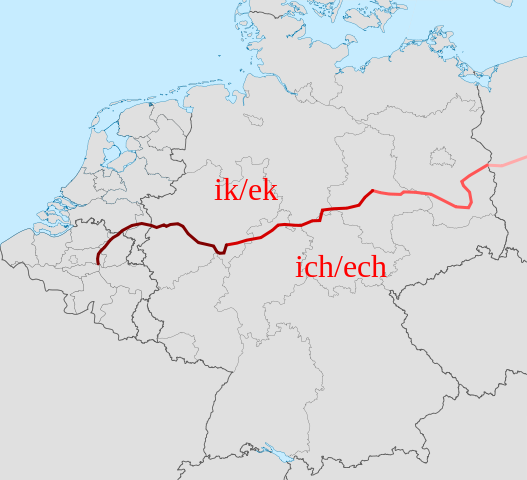
- Plattdeutsch/Niederdeutsch: Wat is dat? (What is that?) // Wo geiht di dat? (Hows it going?)
Hochdeutsch, or “High German,” is the most widely spoken variety of German. In other words, this is the standardized form of the German language. Thus, if you have ever learned German in school, read documents in German, or seen signs out traveling – they are most likely always written, transcribed, and standardized in Hochdeutsch. Plattdeutsch, in contrast, is still technically a dialectal variety of German, but rather than its standardized sibling, Plattdeutsch/Niederdeutsch is more of a verbal linguistic variety, even if the presence of this German language variety has existed since the Middle Ages.
The lesson takeaway here is simply: language is never totally singular. It does not exist as a never-changing totally pure concept. Lots of things, fabricated or real, can change the ways in which humans go about pronouncing/annunciating or writing language forms. Without this productive quality of language, things would never change, new slang would never be invented, and the fascinating artful modes of speech would cease to exist. So when considering any language, just know that there are always multiple ways to go about saying anything, even if the classroom textbooks fail to teach it!
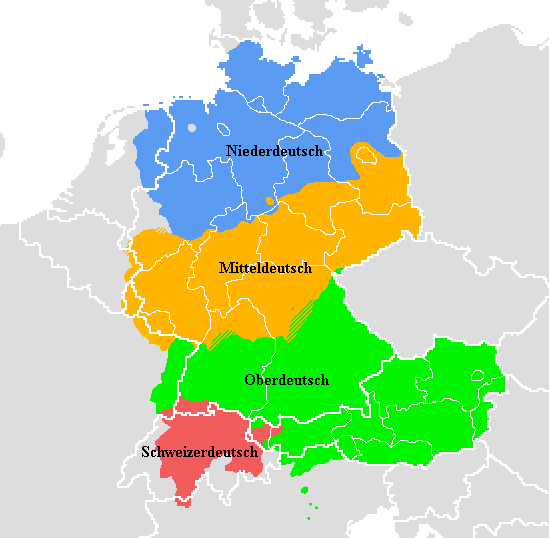
Low German (Plattdeutsch/Niederdeutsch) = In reference to dialects/language used throughout the Northern Plains, and primarily used or spoken in Western parts of Germany, z.B. near the Netherlands!
-
- Oftentimes, when people hear “low,” they associate the concept with class structure, or their minds conjure up logical direction references. This is totally valid! If you have never heard the term Low German before, it would stand to reason that the language would logically come from the lower parts of Germany.
- Oftentimes, when people hear “low,” they associate the concept with class structure, or their minds conjure up logical direction references. This is totally valid! If you have never heard the term Low German before, it would stand to reason that the language would logically come from the lower parts of Germany.
- Yet, the German naming logic differs from what we as Americans might assume. Therefore, this “low” German is not in reference to something like social status, but rather, it actually refers to parts of German geography with low/flat plainlands.
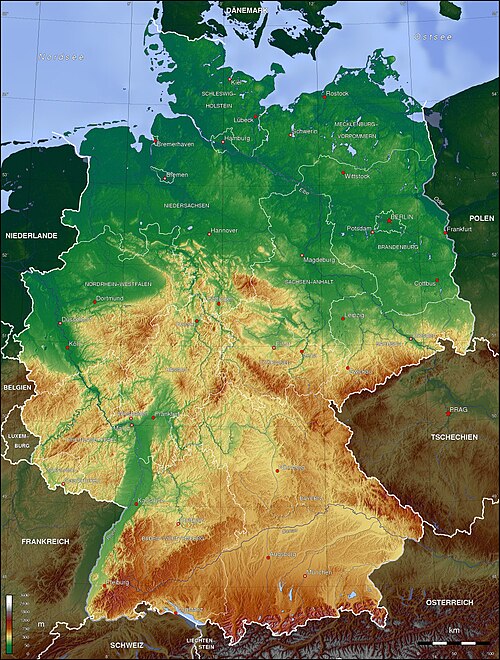
- The Northern German Plains are vast, stretching around the upper parts of the country from the Nordsee (North Sea) to the Ostsee (Baltic Sea). Despite being referred to as Plains, this area of Germany is fertile farmland, similar to the Midwest region of America. Coastal marshlands, port cities, sandy plains, swathes of lush green grasslands, heathlands, usw. and the like all make up this major geographical region of Germany.
- Linguistically, throughout the Middle Ages, essentially from the 13th and up until the late 16th centuries, Plattdeutsch was primarily used as a Lingua Franca* throughout northern parts of Europe. This means it was the primary language of trade, mercantile, diplomacy and commerce there for a while! Sailors from Scandinavia, English territories, and the Netherlands all relied on this dialectal variation of German to go about their business; as a consequence, Plattdeutsch is full of loanwords* and other foreign grammatical features.
- Hence, why some English speakers find Plattdeutsch easier to acquire and understand than Hochdeutsch, as you might notice with wat is dat? Sounding more similar to the English phrase what is that?
- Although Plattdeutsch has such a colorful history, Hochdeutsch eventually gained more prestige over time. Trade routes changed, powers shifted, and Martin Luther’s 1534 German Bible translation of the New Testament inevitably elevated Hochdeutsch beyond Plattdeutsch.
- Today, Plattdeutsch is a regional language with only approx. 2.5 million habitual users.
High German (Hochdeutsch) = In reference to dialects/language used throughout the Southern mountains, and primarily spoken in classrooms, social and other media formats, legal jargon, usw. and so forth. Most conversational German today is considered to be Hochdeutsch as well, as it is the most standardized core form of the modern German language, even if some slang is occasionally mixed in with day-to-day verbiage.
- Because Hochdeutsch is the standard, it is not considered to be a regional variation of German, but rather, a non-geographical standard.
- Despite being the standard, however, there is rarely such a thing as accent-free language. Even in America, although most people speak English and are familiar with the school and legal standards of the language, accents slip in and out all the time. This does not mean Hochdeutsch is totally fabricated, but rather, exemplifies the fact that total standardized ideals of any language are just that: ideals. Regional and dialectal accents are retained, even when formality demands a singular standard form!
- Still, Hochdeutsch, greatly popularized in the mid to late 16th century thanks to Martin Luther’s 1534 German Bible translation of the New Testament, is the baseline for most native and learned speakers of modern German today.
Middle German (Mitteldeutsch) = In reference to dialects/language used throughout the in-between area of the mountainous south (High German) and the flat plains of the north (Low German). In other words, Mitteldeutsch has always been spoken in the central parts of Germany, and evolutionarily serves as somewhat of a bridge between the historic forms known as Old High German and New High German. This means that Mitteldeutsch is as geographical as it is also historically chronological.
- As stated in the explanations of Hochdeutsch and Plattdeutsch above, German and its dialectical variations are divided into categories such as High, Low, and Middle/Central. Middle German, low or high, was primarily used throughout the years of approx. the 1050s until about 1300s, and relates more to the standardized German of today than it does to Plattdeutsch because initially, Martin Luther published his revered German translation of the New Testament in Middle High German in the year 1534.
- Middle High German was impacted by such clerical and legal texts, eventually transitioning in the 1500s, as mentioned above, into )early) New High German
- A note for clarification: (Early) New High German emerged around the 1500s, but is “based” on the Middle German utilized by authorial figures such as Martin Luther.
- While there was no “standard” Middle German throughout the Middle Ages, due to widely read texts published in this variety of German, such as with Martin Luther’s translation of the New Testament, Middle (High) German was pretty quickly accepted and assimilated throughout the noble and larger populations as conventional, and thereby, became formally standard.
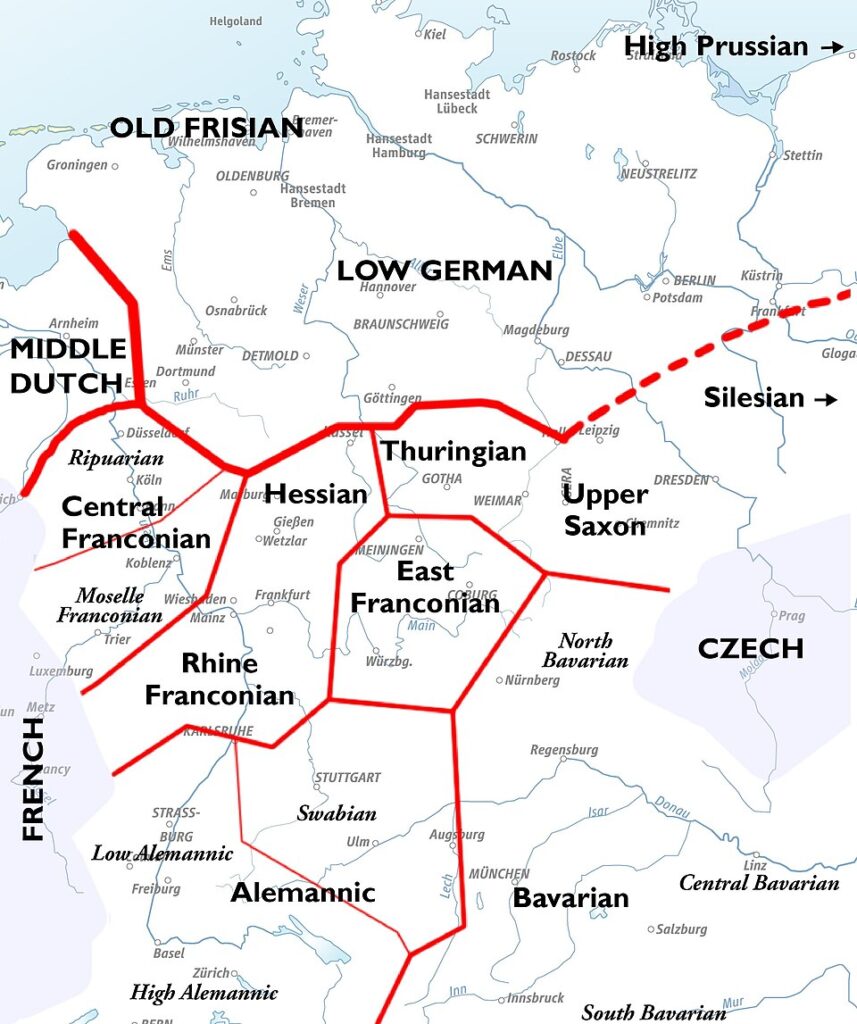
Map of Middle (High) German Dialect/Language Boundaries, Approx. 1050-1350 - Middle High German (11th-14th centuries) experienced a massive rise in population usage during the Middle Ages, but due to a demographic destroying plague (z.B. The Black Death, c.1348) this regional/dialectal variety was catastrophically impacted.
Dialects of Middle German (Mitteldeutsch)
- West Central German (Westmitteldeutsch)
- Central Franconian (Mittelfränkisch)
- Ripuarian (Ripuarisch)
- Moselle Franconian (Moselfränkisch)
- Rhine Franconian (Rheinfränkisch)
- Hessian (Hessisch)
- East Central German (Ostmitteldeutsch)
- Thuringian (Thüringisch)
- Upper Saxon (Obersächsisch)
- Silesian (Schlesisch)
- High Prussian (Hochpreußisch)
*Technically technically technically, one does not need to have an expert understanding of these linguistic concepts or word constructions to understand the general essence of surnames, but… here at the museum, we care about the dissemination of knowledge, which means being dedicated to defining terms when things get a little wordy.
*And so, for those who are interested in strengthening their understanding of word construction, we’ve gone ahead and defined some things for readers anyway!
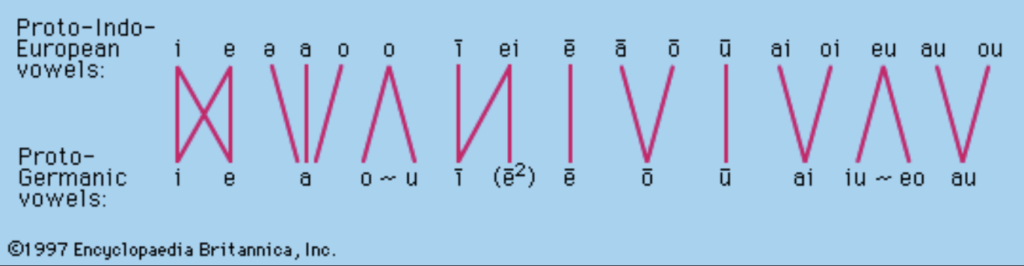
Proto = in linguistic terms, when something is ascribed the “proto” suffix, this is usually in reference to the first, earliest form, root, or source of something, and in this case, language. Modern words, therefore, are derived from their proto-counterparts.
-
- Proto suffix derived from the Greek word prōtos, meaning “first”
- In linguistics, studying proto-forms of language are crucial to understanding how words develop over any given period of time.
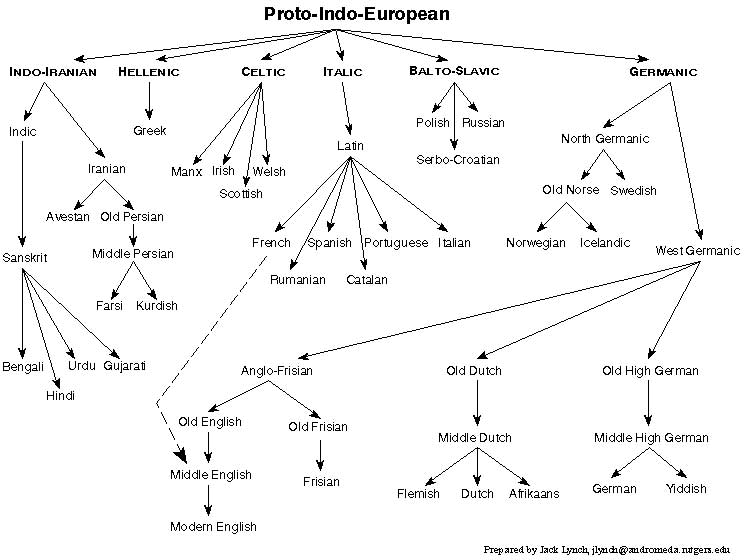
- Proto Indo-European (PIE) – while no record of this initial language exists due to a lack of writing during time of construction, PIE is assumed to have been spoken approx. 6000+ years ago and is the ancestor of the Romance, Germanic, Slavic, Celtic, Indian, Iranian, and Anatolian language families.
- How do we know about Proto languages? Well, because certain words are strikingly similar across the globe, despite having contemporary cultural or grammatical differences.
- Familial terms, for example, seem to align in many languages (German: Vater, Latin: Pater, Sanskrit: pitṛ, Greek: Patéras, etc.).
- Thus, it is hypothesized in linguistics that at some point, all of these languages shared a common source, which today is nonexistent both in writing and verbally.
-
-
- Language Evolution Timeline Example, simplified:
-
Proto Indo-European → Indo-European → Latin → Branched-off Romance Language Forms/Varieties → Modern Standardized Language Forms
Loanword = a loanword can be linguistically defined by: a word which is adopted/assimilated from one language into another. Loanwords often are able to retain their original meanings, but the sound qualities or grammatical rules for the word are often adapted to fit the language of which they have been adopted into.
- Examples of loanwords in English, retained or adapted from other languages:
- From German: kindergarten (literally meaning: a garden for children), angst (fear, worry, dread), pretzel (the German word is brezel, which is not too different *notice the sound/consonant shift?)
- From French: Café, Cliché, Ballet
- From Hindi: Shampoo, Pajamas, Jungle (Jangal)
- From German: kindergarten (literally meaning: a garden for children), angst (fear, worry, dread), pretzel (the German word is brezel, which is not too different *notice the sound/consonant shift?)
Phoneme = to put it plainly, a phoneme is essentially a speech sound. In linguistics, phonemes are the smallest unit of speech, or a word, z.B. the letter p of the word tap.
- For instance, changing the phoneme of the word tap, the word and conception of the word is thereby changed: remove the p and add a b? Suddenly tap becomes tab. As a word, by simply changing one part, we recognize as speakers/readers that this is now a completely different word, and often, an entirely different mental conception as well.
- Pitch, stress, and rhythm can all affect the pronunciation of phonemes.
- Phonology, thereby, is the study of sound patterns as they happen and occur in spoken language.
- Why are phonemes significant? Well, because they are the building blocks of language, and especially in English, which relies on the latin alphabet. Phonomes allow us to spell words, connect sounds to letters, and distinguish between words, as with the example of tap and tab above.
Patronymic and Matryonymic = in order for a surname or title to be considered patronymic or matryonymic, the initial conception/inheritance must be derived from lineage; in other words, passed down from father or mother. Patronymic/matronymic names, in many cultures, literally translate to “son of/daughter of,” (z.B. English: Johnson, Icelandic: Jónsson, German: Johannsen)
- In some cultures and languages, patronymics are denoted as linguistic markers, rather than the “son” being attached on the end:
- Scottish/Irish Prefixes, such as the O’ in O’Brien and the Mac/Mc in MacGuire
- Arabic Prefixes or First Titles, such as the Ibn in Ibn Battuta or Bin in Ali bin Ahmad *similarly also: bint (daughter of)
Habitual and/or Descriptive = in contrast to patronymic surnames, which are inherited and fossilized into lineage/linguistic features of a language, habitual or descriptive surnames are more superficial, essentially meaning that the surname would have initially originated as some type of earned title or nickname. This is typically why some last names are adjective color descriptors (White/Weiss, Black/Schwarz, Brown/Brün, Azure/Blau, usw.) or possibly also in reference to non-occupational verbs (Swift/Schnell, Strong/Stark, Meek/Sanft).
- Habitual/Descriptive surnames give us a glimpse back in time to the characteristics and traits of our ancestors; personalities, behaviors, importances of or notable appearances, usw.
- Most of the time these bynames started initially as just that: nicknames (monikers epithets, usw.), but due to population growth, a need to organize taxation, land ownership documentation, etc. in the Middle Ages, these informal nicknames just sort of… stuck around! Fossiled into legit permanent surnames with hereditary meaning, even if populations shifted, migrated, or married off.
Toponymic (Locational/Geographical/Habitational) = the root of the word might have already given the definition away, but essentially, when a surname is defined/categorized as being toponymic, this is in reference to the geographical location an individual or family inhabited. Toponymic surnames, in contrast to the other varieties of how people come about acquiring surnames, are great indicators of a family’s historical/ancestral roots. This makes it easy to trace back lineage, as habitation or topographic indicators are markers of where a family initially came from/started!
- Toponymic Surnames, Habitationally: when a topographic surname is defined as being habitational, this is because the name derives from a specific place of origin, such as a town, village, estate(s), usw. It differs from topographic in the sense that the surname describes a more broad habitation site (city, village, usw.) rather than the physical characteristics of a landmark or geographic feature (hill, hallow, mountain, stream, usw.)
- Habitational Surname Example: Müncher – literally, someone who comes from München (Munich)
- Toponymic Surnames, Topographically: as slightly described above, topographic toponymic surnames describe/relate to characteristics of a landscape. These can be highly descriptive (z.B. the elevation of a terrain) or more basic (z.B. simply: hill). They are classified under topography because they do not originate from an already-named town/city/village, but rather, from prominent physical features of earth’s surface.
- Topographic Surname Example: Schwarzwald – literally, someone who lives (or lived) near/within/on the outskirts of the Black Forest
Occupational = occupational surnames are denoted under this categorization because, as the title explains, this initial mode of entitlement derives from a person’s occupation/job, with a majority of these trade-based titles stemming from the Middle Ages, as work and class distinguished individuals and families within populations and often were full-life commitments which saw little class promotion or change.
- And so a smither, for example, would be brought up and into the trade throughout the early stages of their life, eventually promoted from apprentice status to full-professional, and then work until they were no longer able to.
- Since this was the nature of occupations throughout the Middle Ages, surnames derived from occupation served as announcements of skill/trade, and official titles which helped persons distinguish themselves in a population from others of slightly similar backgrounds, z.B. Konrad the Smither would be considered as different from Gotthard the Miller.
- This kind of clarification helped courts/other forms of government around medieval Europe organize tax documents, classify land ownership, draft for militias, with cartography and boundaries, usw.
- If your family surname is something occupational (smith, baker, miller, usw.), this gives insight to how your ancestors made a living many ages ago! Pretty neat, right?
Contributed by Lily May Jewell