Skip to content
  • Visit
    • TOURS
    • Accessibility
    • HOURS & LOCATION
    • BECOME A MEMBER
    • ADMISSION
    • GIFT SHOP
  • Exhibits
    • The German Immigrant Experience
    • Play On! German Immigrants and the Quad Cities’ Musical Legacy
    • Violins of Hope Iowa
    • Past Exhibitions
  • Learn
    • GAHC From Home
    • Internships
    • Resources
    • Translation Services
    • Book Discussions​
    • Travel
  • Events
  • About
    • About Us
    • Collections
    • DEAI Statement
    • Staff
    • Employment Opportunities
    • Newsletter
    • Contact Us
    • Media Kit
  • Private Events
  • Donate
  • Visit
    • TOURS
    • Accessibility
    • HOURS & LOCATION
    • BECOME A MEMBER
    • ADMISSION
    • GIFT SHOP
  • Exhibits
    • The German Immigrant Experience
    • Play On! German Immigrants and the Quad Cities’ Musical Legacy
    • Violins of Hope Iowa
    • Past Exhibitions
  • Learn
    • GAHC From Home
    • Internships
    • Resources
    • Translation Services
    • Book Discussions​
    • Travel
  • Events
  • About
    • About Us
    • Collections
    • DEAI Statement
    • Staff
    • Employment Opportunities
    • Newsletter
    • Contact Us
    • Media Kit
  • Private Events
  • Donate

Kaffee und Kuchen

March 9, 2025 |
 1:30 pm -
 3:30 pm
FREE

Register Here

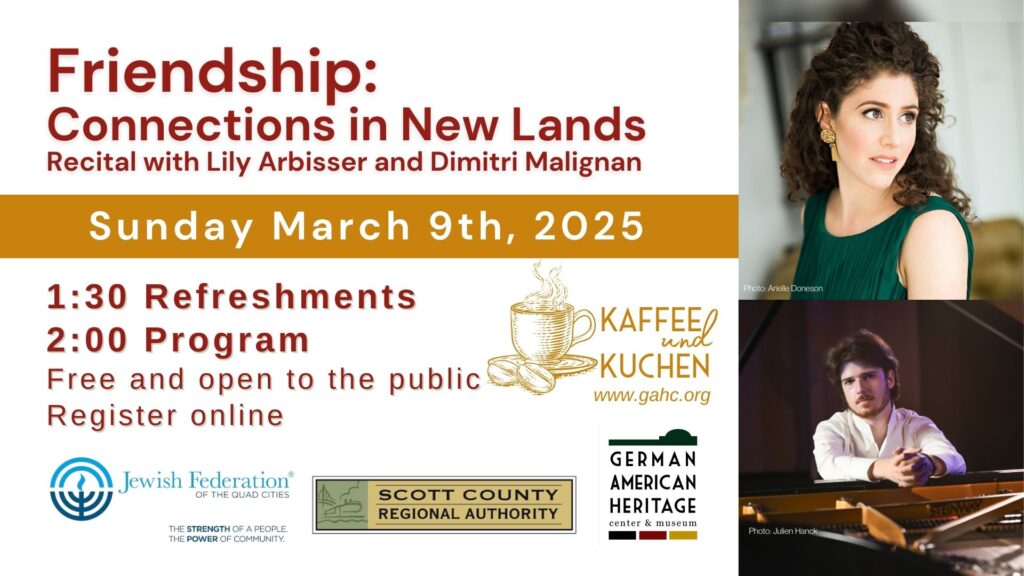
Join us for a musical performance, Friendship: Connections in New Lands

The German American Heritage Center & Museum and The Jewish Federation of the Quad Cities are pleased to present soprano Lily Arbisser and esteemed French pianist Dimitri Malignan in the recital “Friendship: Connections in New Lands.”

Inspired by Oranit Ben Zimra’s photography exhibition Mit dir bin ich ich/With You, I Am Myself currently on view at the GAHC+M, the recital similarly investigates friendship, how it strengthens us and knows no borders. Audiences will be treated to a program featuring the music of: Arnold Schoenberg and his friend George Gershwin; and Dmitri Shostakovich and dear friend Mieczysław Weinberg. These friendships developed after Weinberg and Schoenberg were forced to emigrate (the former from Poland to Minsk; the latter from Austria to Los Angeles) due to the anti semitic atmosphere in their respective countries before and during World War II. Please join us for this celebration of friendship.

1:30 refreshments
2:00 program

FREE and open to the public. Donations appreciated.

RSVP HERE
This program is sponsored by the Scott County Regional Authority.


About the performers:

Photo: Arielle Doneson

A native Quad Citizen and frequent soloist in the area, Lily Arbisser is an “individual-timbred soprano” (Opera News) whose voice “floats effortlessly” (www.feastofmusic.com) over the orchestra. Highlights of recent seasons include joining Ravinia’s Steans Music Institute in Chicago as a vocal fellow, being a semi-finalist in the Kurt Weill Foundation’s prestigious Lotte Lenya Competition, and winning first prize in the National Federation of Music Clubs’ Biennial Young Artist Competition. In addition to frequent appearances as a soloist on oratorio and operatic stages, Lily is dedicated to the art of the recital, performing beloved songs from the traditional canon alongside lesser-known
works. In 2025, she is thrilled to be on stage with friend and collaborator Dimitri Malignan and his “Missing Voices” project, and she also appears as Amour in Gluck’s “Orphée et Eurydice” in New York City, as well as sings the soprano solo in Fauré’s “Requiem” with The Choral Society of the Hamptons. Lily’s artistry is grounded in the understanding gained from studying in the Libero Canto TM  School of Singing with her teachers Deborah Carmichael and Kinga Cserjési. Libero Canto is a process-oriented approach which holds that the body instinctually knows how to sing but is frequently blocked by psycho- social factors that inhibit freer singing. Lily graduated summa cum laude and Phi Beta Kappa from Princeton University with a Bachelor of the Arts in Art and Archaeology and a Certificate in Vocal Performance. She holds a Master of Music degree from Mannes College. When not singing, she can be found outdoors cultivating her passion for ecological restoration and native plant gardening.
www.lilyarbisser.com

Photo: Julien Hanck

Brilliant young French pianist Dimitri Malignan impresses juries, critics, and the public with his level of maturity, his musical intelligence, and great sensibility. Winner at only 19 years of age of the Prix Cortot 2017, he was awarded in 2021 the 3rd Prize as well as the Audience Award and the Bach Award at the Concours Musical International de Montréal. Dimitri performs in concert venues around the world and has also recorded multiple CDs as both a soloist and a chamber musician, including two new releases in 2024: one dedicated to Pál Hermann (Toccata Classics), and another entitled “Elegies and Echoes” with soprano Elizaveta Agrafenina (Sheva Collection). Two new albums will be published in 2025, with music by Henriëtte Bosmans and Dan Belinfante (Editions Hortus). Dimitri is passionate about promoting unknown music. In 2020, he initiated the “Missing Voices” project, dedicated to Jewish composers who were murdered in the Shoah and curates concerts, CD recordings, and exhibitions. Dimitri began his piano studies at the age of 5 with Nicolas Horvath. He has since studied with several masters of diverse backgrounds and in multiple countries and holds degrees from The École Normale de Musique de Paris “Alfred Cortot,” where he studied under Ludmila Berlinskaya, and the Conservatory of Amsterdam (the Netherlands), where he studied with Naum Grubert. He is currently in the prestigious class of Benedetto Lupo at the Academy of Santa Cecilia in Rome (Italy). His 2025 concert season includes performances at the European Parliament in Brussels, the Goethe-Institut in Paris, the Museum of Musical Instruments in Rome, and a South-East Asian Tour in the Fall.  Dimitri has been regularly practicing Qi Gong, Tai Chi and Feldenkrais for many years. He is convinced of their beneficial aspects for a healthy musicianship. He is also passionate about tennis and aviation and is often to be found training on flight simulators.

  • Add to Google Calendar
  • Add to iCalendar
ON INSTAGRAM
  • Follow Us!

German American Heritage Center and Museum

germanamericanheritagecenter

1,373 1,715

Museum exploring the German immigrant experience and history of Davenport and Iowa!

Open
Behind the scenes of our Violins of Hope installation! Now open, this exhibition showcases violins that have a connection to Jewish musicians connected to the Holocaust. Through these instruments, we learn about the unique experiences of their owners, if they are known. 
Visit the museum now through April 26th to see the Violins of Hope on display.
📍 712 W Second St. Davenport, Iowa

Behind the scenes of our Violins of Hope installation! Now open, this exhibition showcases violins that have a connection to Jewish musicians connected to the Holocaust. Through these instruments, we learn about the unique experiences of their owners, if they are known.
Visit the museum now through April 26th to see the Violins of Hope on display.
📍 712 W Second St. Davenport, Iowa
…

Open
The Violins of Hope is a state-wide commuinty collaboration to honor and preserve the stories of those impacted by the Holocaust. For many musicians, their violins were their key to survival. By playing in orchestras and in camps, Jewish violinists were kept alive for their ability to provide music. 

We will have several violins on display with the stories of their owners at the German American Heritage Center and Museum in Davenport, Iowa through April 26th. For more information and other exhibitions and events, visit www.violinsofhopeiowa.com

The Violins of Hope is a state-wide commuinty collaboration to honor and preserve the stories of those impacted by the Holocaust. For many musicians, their violins were their key to survival. By playing in orchestras and in camps, Jewish violinists were kept alive for their ability to provide music.

We will have several violins on display with the stories of their owners at the German American Heritage Center and Museum in Davenport, Iowa through April 26th. For more information and other exhibitions and events, visit www.violinsofhopeiowa.com
…

Open
Happy Birthday, Jacob Strasser!

Born on February 22, 1831, Strasser immigrated to New Orleans with his family at the age of ten and ultimately settled in Davenport in 1851. His love of music played a key role in shaping German musical culture in the city. Around 1855, the Strasser Band emerged, featuring Strasser and several other local musicians. Frequently performing at picnics, street parades, and community events, the band thrived throughout the decade. Associated with the Iowa National Guard, the Strasser Band grew in popularity and traveled around the region to perform at special occasions, including the 1893 World’s Fair in St. Louis.

As the band’s reputation expanded, its musical influence helped lay the groundwork for the creation of the Quad City Symphony Orchestra (originally known as the Tri-City Symphony) in 1916. Remarkably, this symphony developed in what was then the smallest community in the United States able to sustain a full orchestra, a lasting testament to the strong musical culture that Strasser helped to foster.

We have some Strasser's Band artifacts on display in our current exhibition, "Play On! German Influence on QC Music History," on display through August 2nd, 2026.

Happy Birthday, Jacob Strasser!

Born on February 22, 1831, Strasser immigrated to New Orleans with his family at the age of ten and ultimately settled in Davenport in 1851. His love of music played a key role in shaping German musical culture in the city. Around 1855, the Strasser Band emerged, featuring Strasser and several other local musicians. Frequently performing at picnics, street parades, and community events, the band thrived throughout the decade. Associated with the Iowa National Guard, the Strasser Band grew in popularity and traveled around the region to perform at special occasions, including the 1893 World’s Fair in St. Louis.

As the band’s reputation expanded, its musical influence helped lay the groundwork for the creation of the Quad City Symphony Orchestra (originally known as the Tri-City Symphony) in 1916. Remarkably, this symphony developed in what was then the smallest community in the United States able to sustain a full orchestra, a lasting testament to the strong musical culture that Strasser helped to foster.

We have some Strasser`s Band artifacts on display in our current exhibition, "Play On! German Influence on QC Music History," on display through August 2nd, 2026.
…

Open
🎆 In 2026, we celebrate the semiquincentennial (250) of the United States! Follow along as we highlight influential German immigrants throughout the history of the United States.

In 1683, thirteen German Mennonite, Quaker, and Pietist families led by Franz Daniel Pastorius (September 26, 1651 – February 17, 1719), crossed the Atlantic in search of religious freedom. Together, they purchased 43,000 acres in Pennsylvania and founded Germantown, a small community north of Philadelphia, now part of the city itself.

These settlers brought with them deep farming traditions and craftsmanship that quickly earned admiration in the colonies. Under Pastorius’s leadership, the community also took a remarkable moral stand: they issued the first known protest against slavery in America, condemning it as unjust and banning it within their settlement.

Their settlement laid the foundation for centuries of German-American contributions to Pennsylvania and beyond.

Pictured: "A Quaker's Meeting," painting by Egbert von Heemskerk.
Pennsylvania Historical Commission Marker.

🎆 In 2026, we celebrate the semiquincentennial (250) of the United States! Follow along as we highlight influential German immigrants throughout the history of the United States.

In 1683, thirteen German Mennonite, Quaker, and Pietist families led by Franz Daniel Pastorius (September 26, 1651 – February 17, 1719), crossed the Atlantic in search of religious freedom. Together, they purchased 43,000 acres in Pennsylvania and founded Germantown, a small community north of Philadelphia, now part of the city itself.

These settlers brought with them deep farming traditions and craftsmanship that quickly earned admiration in the colonies. Under Pastorius’s leadership, the community also took a remarkable moral stand: they issued the first known protest against slavery in America, condemning it as unjust and banning it within their settlement.

Their settlement laid the foundation for centuries of German-American contributions to Pennsylvania and beyond.

Pictured: "A Quaker`s Meeting," painting by Egbert von Heemskerk.
Pennsylvania Historical Commission Marker.
…

Open
💝 Valentine’s Day is a relatively new tradition in Germany, compared to places like England or France, where romantic customs around February 14 developed much earlier. For centuries, German-speaking regions focused more on religious feast days and local folk traditions than on St. Valentine as a patron of lovers. Romantic Valentine customs started to appear in Germany only in the late 19th and early 20th centuries, influenced by British and American fashions like printed cards and heart-shaped sweets. The real boom came after World War II, when American, British, and French troops stationed in Germany brought over their Valentine’s cards, chocolates, and “day of love” marketing. From the 1950s onward, German florists, chocolatiers, and card companies leaned into the holiday, helping it spread through shops, advertising, and later television and social media.

💐 Today, “Valentinstag” in Germany looks familiar: many couples exchange flowers, chocolates, and small gifts or go out for a quiet dinner, though the day is often less flashy and more low-key than in the United States. Its growth is a clear example of cultural exchange, showing how a once-local European saint’s day became a global celebration, reshaped as it moved between Britain, North America, and postwar Germany.

❤️ These Valentine cards are on display on our 4th floor, on loan from the American Doll and Toy Museum in Rock Island. Many of these vintage cards were elaborate, featuring pop-up elements, moving parts, or multi layered construction. Do you have any old Valentine cards? Share them with us in the comments!

💝 Valentine’s Day is a relatively new tradition in Germany, compared to places like England or France, where romantic customs around February 14 developed much earlier. For centuries, German-speaking regions focused more on religious feast days and local folk traditions than on St. Valentine as a patron of lovers. Romantic Valentine customs started to appear in Germany only in the late 19th and early 20th centuries, influenced by British and American fashions like printed cards and heart-shaped sweets. The real boom came after World War II, when American, British, and French troops stationed in Germany brought over their Valentine’s cards, chocolates, and “day of love” marketing. From the 1950s onward, German florists, chocolatiers, and card companies leaned into the holiday, helping it spread through shops, advertising, and later television and social media.

💐 Today, “Valentinstag” in Germany looks familiar: many couples exchange flowers, chocolates, and small gifts or go out for a quiet dinner, though the day is often less flashy and more low-key than in the United States. Its growth is a clear example of cultural exchange, showing how a once-local European saint’s day became a global celebration, reshaped as it moved between Britain, North America, and postwar Germany.

❤️ These Valentine cards are on display on our 4th floor, on loan from the American Doll and Toy Museum in Rock Island. Many of these vintage cards were elaborate, featuring pop-up elements, moving parts, or multi layered construction. Do you have any old Valentine cards? Share them with us in the comments!
…

Open
🏈 Did someone say football??

These postcards are from a 1914 game between the Rock Island Independents and the Moline Redmen. The Rock Island Independents were a founding franchise of the National Football League. They hosted the first NFL game on September 26, 1920, at Douglas Park in Rock Island, IL.  These photos were donated to the GAHC+M by Anita Purcell.

🍺 🇩🇪 If you have plans this Sunday or need a last-minute contribution to the Super Bowl Party, we've marked down our beers to $10 for a 4 pack. We have a variety of Paulaner beers and our custom Hefeweizen and Märzen brewed locally by Twin Span Brewing. Build your own combo and try them all!

🥒 We also have Sprecher root beer, cream soda, and cherry cola for NA options. If you're feeling snacky, we also have various German pickles, kraut, and Boetje's mustard!

✅ As a non-profit organization, all of our gift shop merchandise is tax-free. 

We are open Friday and Saturday 10 am - 4 pm  and Sunday 12 - 4 pm.

🏈 Did someone say football??

These postcards are from a 1914 game between the Rock Island Independents and the Moline Redmen. The Rock Island Independents were a founding franchise of the National Football League. They hosted the first NFL game on September 26, 1920, at Douglas Park in Rock Island, IL. These photos were donated to the GAHC+M by Anita Purcell.

🍺 🇩🇪 If you have plans this Sunday or need a last-minute contribution to the Super Bowl Party, we`ve marked down our beers to $10 for a 4 pack. We have a variety of Paulaner beers and our custom Hefeweizen and Märzen brewed locally by Twin Span Brewing. Build your own combo and try them all!

🥒 We also have Sprecher root beer, cream soda, and cherry cola for NA options. If you`re feeling snacky, we also have various German pickles, kraut, and Boetje`s mustard!

✅ As a non-profit organization, all of our gift shop merchandise is tax-free.

We are open Friday and Saturday 10 am – 4 pm and Sunday 12 – 4 pm.
…

Open
New workshop just added! 

Valentine Card Workshop Saturday February 14th at 11:00 am.

Join us on Valentine's Day for a fun opportunity to make your own Valentine Cards. Instructed by Rachael Mullins, draw inspiration from vintage Valentines and use the provided materials to create your own one-of-a-kind cards.

No experience needed! This would be a wonderful way to unplug, and spend time with a friend, partner, or family member creating something unique and festive.

Registration link in bio. Walk-ins welcome if there is space available.

Pictured: Valentine card from the GAHC+M collection. Pre-WWII, donated by Linda Foster. 2022.10.5F

New workshop just added!

Valentine Card Workshop Saturday February 14th at 11:00 am.

Join us on Valentine`s Day for a fun opportunity to make your own Valentine Cards. Instructed by Rachael Mullins, draw inspiration from vintage Valentines and use the provided materials to create your own one-of-a-kind cards.

No experience needed! This would be a wonderful way to unplug, and spend time with a friend, partner, or family member creating something unique and festive.

Registration link in bio. Walk-ins welcome if there is space available.

Pictured: Valentine card from the GAHC+M collection. Pre-WWII, donated by Linda Foster. 2022.10.5F
…

Open
Today is International Holocaust Remembrance Day. 81 years ago, Soviet soldiers liberated the Auschwitz-Birkenau concentration camp, where over one million people were murdered.

On this day, we honor the six million Jewish victims of the Holocaust, along with countless others who suffered under Nazi persecution. We remember their lives, their stories, and their humanity.

Holocaust Remembrance Day calls on us to confront hatred in all its forms and to recognize the patterns that lead to genocide. Remembering is not only about the past, it’s about shaping a more just and compassionate future.

This February, we are partnering with the Jewish Federation of the Quad Cities and several other community partners to bring Violins of Hope to Iowa. 

Violins of Hope is an international collection of historic string instruments connected to Jewish musicians and the Holocaust. Many of these instruments were played in ghettos, concentration camps, and in hiding. Lovingly restored by the Weinstein family, the instruments now travel the world sharing stories of resilience, hope and the enduring power of music. The instruments were restored to be played as part of a living exhibition to honor those who were lost while celebrating the strength of those who endured.

One of several instruments that will be on display at the GAHC+M is the “Auschwitz Violin.” Made in the workshop of Schweitzer in Germany, around 1850, this instrument was originally owned by an inmate who played in the men’s orchestra at the concentration camp in Auschwitz and survived. 

Many years later,  this violin was donated to Violins of Hope to be fully restored and come back to life. Since then, this violin, now restored to perfect condition, has been played in concerts by the best musicians all over the world.

Today is International Holocaust Remembrance Day. 81 years ago, Soviet soldiers liberated the Auschwitz-Birkenau concentration camp, where over one million people were murdered.

On this day, we honor the six million Jewish victims of the Holocaust, along with countless others who suffered under Nazi persecution. We remember their lives, their stories, and their humanity.

Holocaust Remembrance Day calls on us to confront hatred in all its forms and to recognize the patterns that lead to genocide. Remembering is not only about the past, it’s about shaping a more just and compassionate future.

This February, we are partnering with the Jewish Federation of the Quad Cities and several other community partners to bring Violins of Hope to Iowa.

Violins of Hope is an international collection of historic string instruments connected to Jewish musicians and the Holocaust. Many of these instruments were played in ghettos, concentration camps, and in hiding. Lovingly restored by the Weinstein family, the instruments now travel the world sharing stories of resilience, hope and the enduring power of music. The instruments were restored to be played as part of a living exhibition to honor those who were lost while celebrating the strength of those who endured.

One of several instruments that will be on display at the GAHC+M is the “Auschwitz Violin.” Made in the workshop of Schweitzer in Germany, around 1850, this instrument was originally owned by an inmate who played in the men’s orchestra at the concentration camp in Auschwitz and survived.

Many years later, this violin was donated to Violins of Hope to be fully restored and come back to life. Since then, this violin, now restored to perfect condition, has been played in concerts by the best musicians all over the world.
…

VISIT US

German American Heritage Center & Museum
712 W 2nd St.
Davenport, IA 52802

HOURS

Tuesdays – Saturdays open 10 am – 4 pm
Sundays open 12 – 4 pm
Closed Mondays

NEWSLETTER

This field is for validation purposes and should be left unchanged.
STAY CONNECTED
Instagram Facebook-f Twitter
Sign Up for our Newsletter
German American Heritage Center & Museum
712 W 2nd St.
Davenport, IA 52802
Tuesdays – Saturdays open 10 am – 4 pm
Sundays open 12 – 4 pm
Closed Mondays

Newsletter

Subscribe to get all latest news, updates.

This field is for validation purposes and should be left unchanged.