Skip to content
  • Visit
    • TOURS
    • Accessibility
    • HOURS & LOCATION
    • BECOME A MEMBER
    • ADMISSION
    • GIFT SHOP
  • Exhibits
    • The German Immigrant Experience
    • Play On! German Immigrants and the Quad Cities’ Musical Legacy
    • Violins of Hope Iowa
    • Past Exhibitions
  • Learn
    • GAHC From Home
    • Internships
    • Resources
    • Translation Services
    • Book Discussions​
    • Travel
  • Events
  • About
    • About Us
    • Collections
    • DEAI Statement
    • Staff
    • Employment Opportunities
    • Newsletter
    • Contact Us
    • Media Kit
  • Private Events
  • Donate
  • Visit
    • TOURS
    • Accessibility
    • HOURS & LOCATION
    • BECOME A MEMBER
    • ADMISSION
    • GIFT SHOP
  • Exhibits
    • The German Immigrant Experience
    • Play On! German Immigrants and the Quad Cities’ Musical Legacy
    • Violins of Hope Iowa
    • Past Exhibitions
  • Learn
    • GAHC From Home
    • Internships
    • Resources
    • Translation Services
    • Book Discussions​
    • Travel
  • Events
  • About
    • About Us
    • Collections
    • DEAI Statement
    • Staff
    • Employment Opportunities
    • Newsletter
    • Contact Us
    • Media Kit
  • Private Events
  • Donate

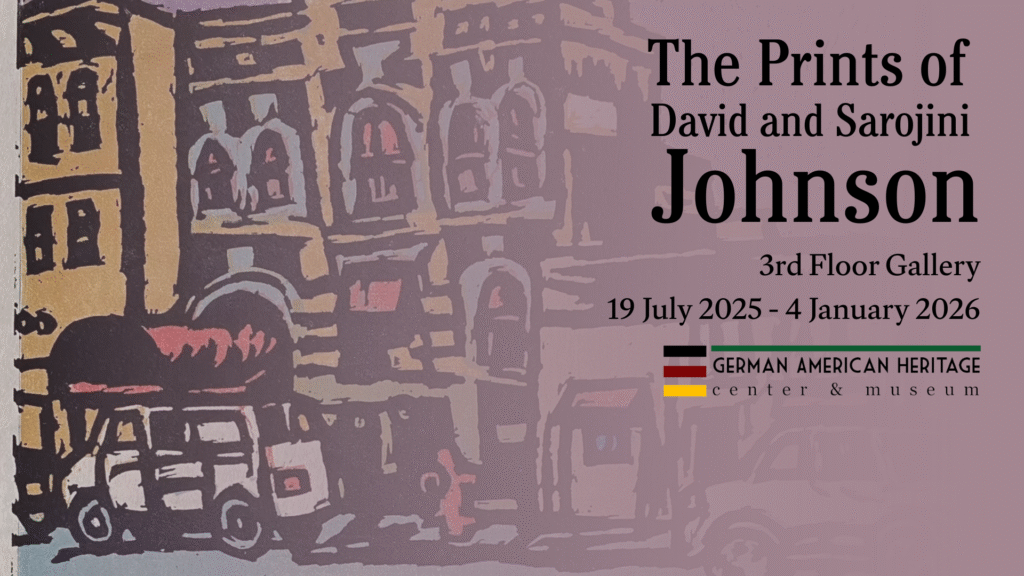
The Prints of David and Sarojini Johnson

The Prints of David and Sarojini Johnson

Plan your visit

July 19th, 2025 – January 4th, 2026

3rd Floor Gallery

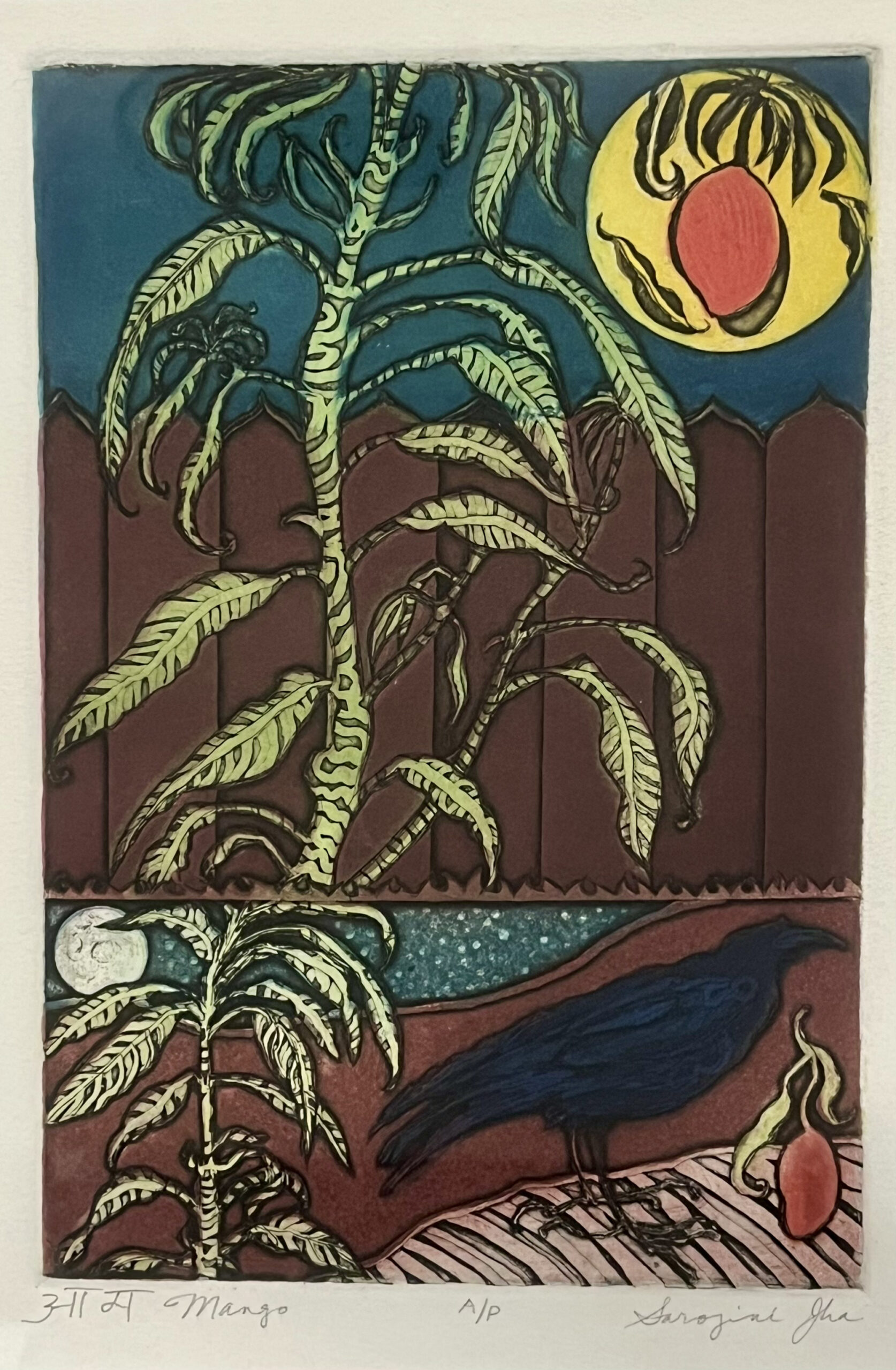
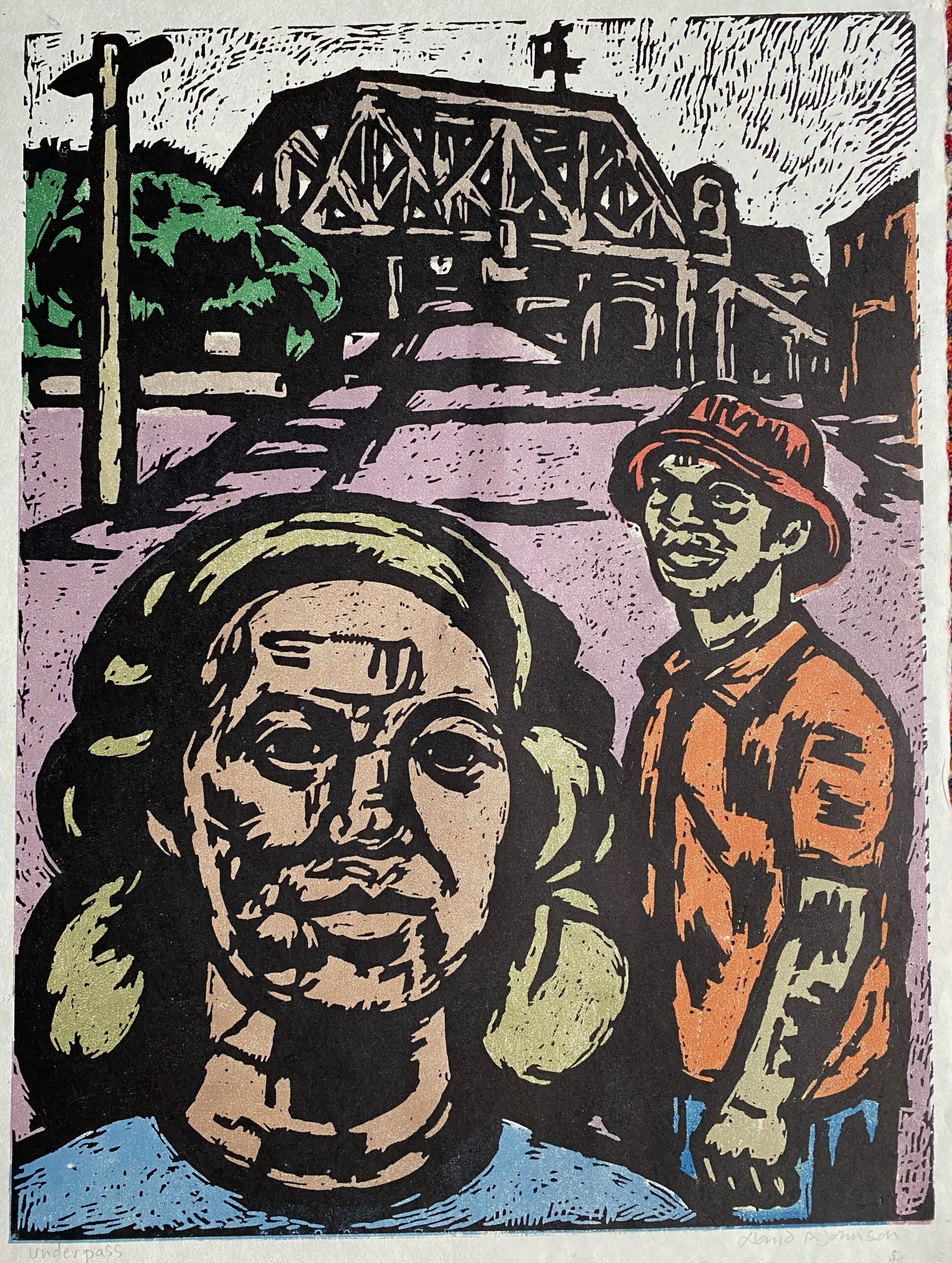
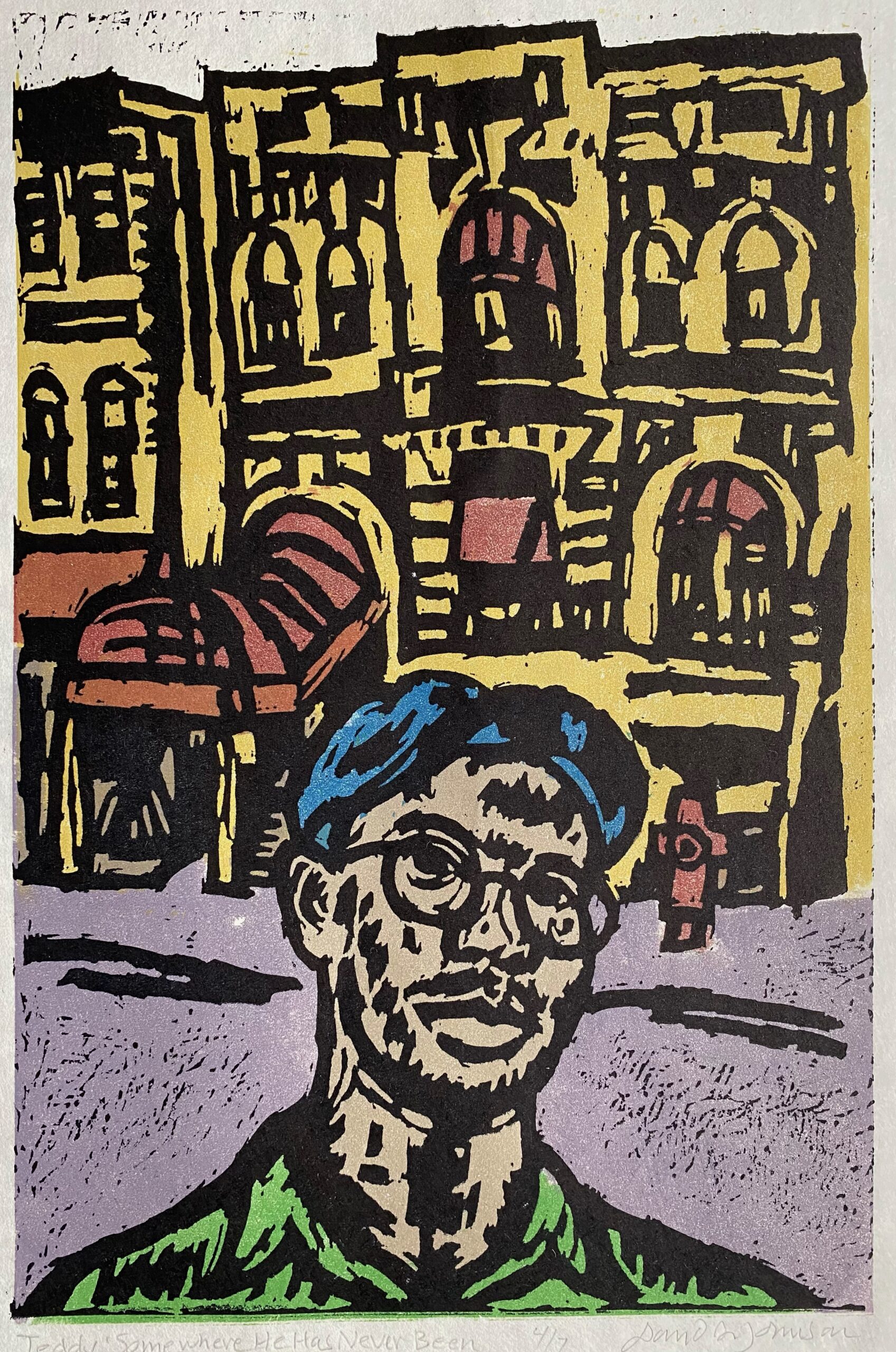
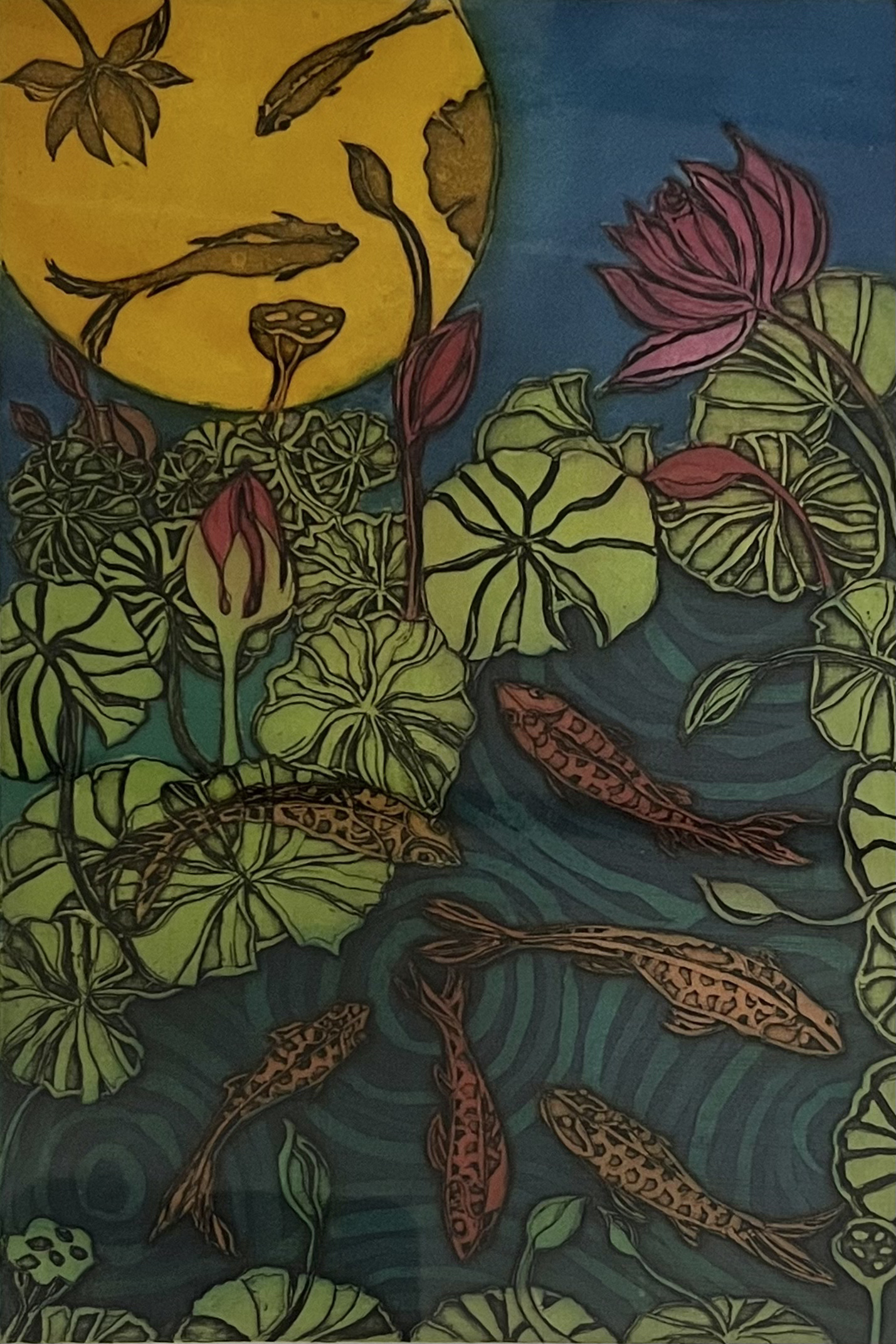
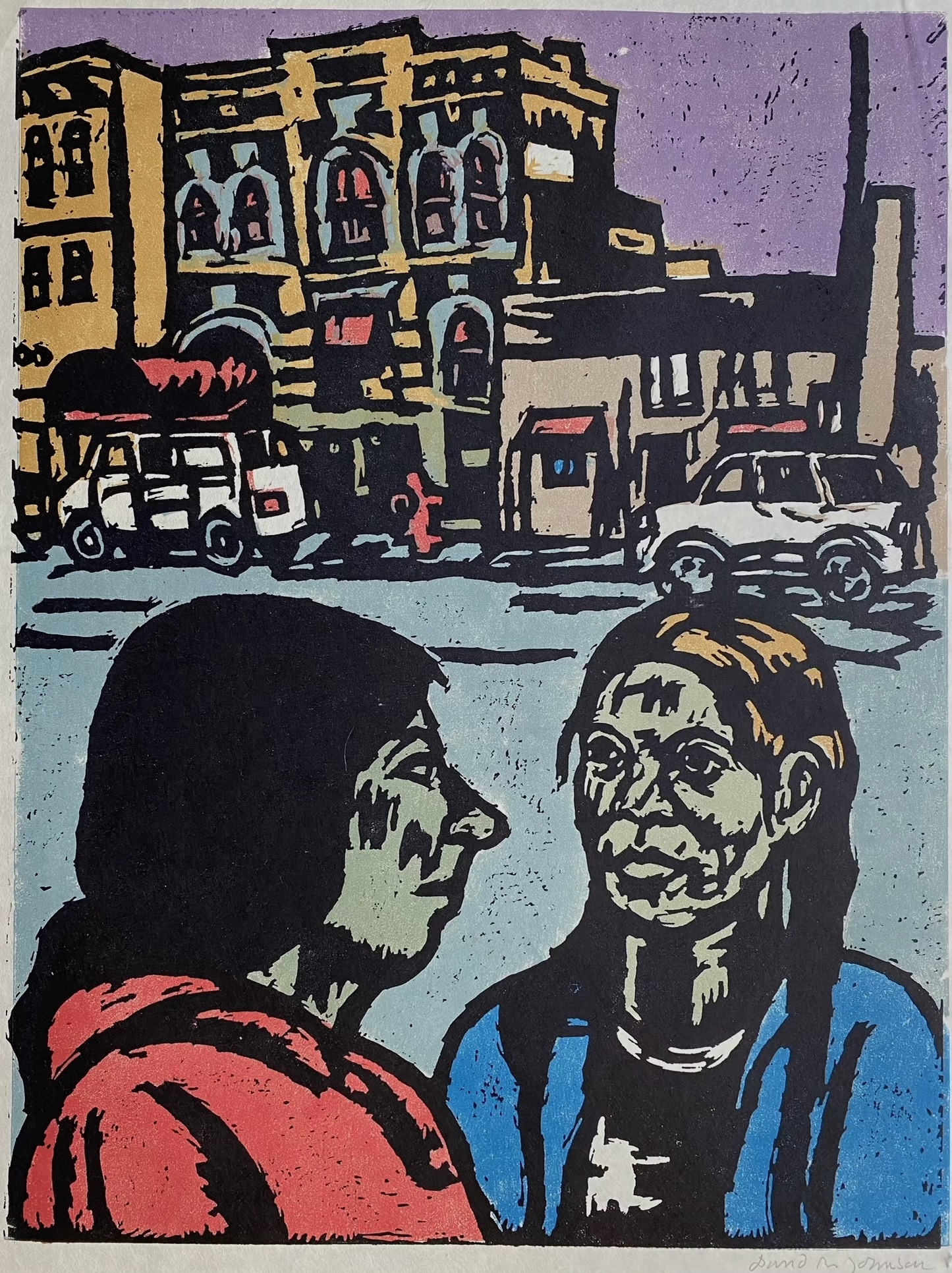
Collectors, educators, and artists David and Sarojini Johnson have spent decades sharing and practicing the art of printmaking. Each with their own vision and inspiration, together, their works represent a beautiful partnership and interpretation of the medium.

Explore the themes of nostalgia, community, nature, and perspective in is wonderful collection of works.


Companion events: 

Sunday August 10th –  Kaffee und Kuchen
 

Artist Statements

David Johnson

I don’t need a photograph to tell me what the world looks like. And we all see the world differently. Two peoples’ versions of any occurrence are always different.  

Drawing is a way of attempting to see and understand the world.  It is a graphic representation, a translation of vision into pencil lines. Sometimes we have to draw quickly, with haste. Perhaps it is getting dark or it is going to rain, the model has things to do and doesn’t want to sit all day.  There is such a thing as urgency.

An etching or a relief print elaborates and enriches the drawing and often translates it into something with added dynamics.   

What does it feel like to walk down the street, to be in the world?

He lives in Iowa City.

Sarojini Jha Johnson

My family came to the United States from India many years ago. My work reflects my preoccupation with my knowledge of India as I have experienced it through my journeys there and through stories told by my parents. Certain objects and images are persistent in my mind and are emblematic or evocative of many things, from mundane to sublime.


Some of these objects are plants such as datura and images of favorite deities such as Ganesha and Lakshmi. Uprooted people often experience a longing for things that remind them of their former home. This sort of nostalgia or yearning for familiar things, especially food, has been a part of my family’s experience for as long as I can remember.


My father grew exotic vegetables with names I do not even know in English. This amuses and amazes me. I believe that the dialog about culture and nationality is vital and that the visual arts are an important forum for communication of the subtleties and variations of individual viewpoints. Recently I have been making artist’s books that delve into the issues of climate change and the effects of human folly on the natural world. I also sometimes celebrate the beauty and mystery of the universe in these works.

Biography

Sarojini Jha Johnson has taught printmaking and foundations at Ball State University since 1985. She grew up in Ohio and earned undergraduate degrees in French and drawing from the University of Cincinnati. She received an MFA in printmaking from Miami University where she began working with animal and plant forms in her prints.  Her work places natural forms in a fictional context. An essential theme expressed is the human desire to make time stand still in order to experience a particular moment in time. Her main medium is color intaglio printmaking, a medium that allows for great creativity and invention in terms of surface and color. Recently, she has been exploring memories and impressions of India, her country of origin. Animal images such as fish and birds still emerge in this work. She also makes books that highlight the devastating effects of humankind’s tampering with nature by introducing flora and fauna that take over. 

ON INSTAGRAM
  • Follow Us!

German American Heritage Center and Museum

germanamericanheritagecenter

1,369 1,693

Museum exploring the German immigrant experience and history of Davenport and Iowa!

Open
💝 Valentine’s Day is a relatively new tradition in Germany, compared to places like England or France, where romantic customs around February 14 developed much earlier. For centuries, German-speaking regions focused more on religious feast days and local folk traditions than on St. Valentine as a patron of lovers. Romantic Valentine customs started to appear in Germany only in the late 19th and early 20th centuries, influenced by British and American fashions like printed cards and heart-shaped sweets. The real boom came after World War II, when American, British, and French troops stationed in Germany brought over their Valentine’s cards, chocolates, and “day of love” marketing. From the 1950s onward, German florists, chocolatiers, and card companies leaned into the holiday, helping it spread through shops, advertising, and later television and social media.

💐 Today, “Valentinstag” in Germany looks familiar: many couples exchange flowers, chocolates, and small gifts or go out for a quiet dinner, though the day is often less flashy and more low-key than in the United States. Its growth is a clear example of cultural exchange, showing how a once-local European saint’s day became a global celebration, reshaped as it moved between Britain, North America, and postwar Germany.

❤️ These Valentine cards are on display on our 4th floor, on loan from the American Doll and Toy Museum in Rock Island. Many of these vintage cards were elaborate, featuring pop-up elements, moving parts, or multi layered construction. Do you have any old Valentine cards? Share them with us in the comments!

💝 Valentine’s Day is a relatively new tradition in Germany, compared to places like England or France, where romantic customs around February 14 developed much earlier. For centuries, German-speaking regions focused more on religious feast days and local folk traditions than on St. Valentine as a patron of lovers. Romantic Valentine customs started to appear in Germany only in the late 19th and early 20th centuries, influenced by British and American fashions like printed cards and heart-shaped sweets. The real boom came after World War II, when American, British, and French troops stationed in Germany brought over their Valentine’s cards, chocolates, and “day of love” marketing. From the 1950s onward, German florists, chocolatiers, and card companies leaned into the holiday, helping it spread through shops, advertising, and later television and social media.

💐 Today, “Valentinstag” in Germany looks familiar: many couples exchange flowers, chocolates, and small gifts or go out for a quiet dinner, though the day is often less flashy and more low-key than in the United States. Its growth is a clear example of cultural exchange, showing how a once-local European saint’s day became a global celebration, reshaped as it moved between Britain, North America, and postwar Germany.

❤️ These Valentine cards are on display on our 4th floor, on loan from the American Doll and Toy Museum in Rock Island. Many of these vintage cards were elaborate, featuring pop-up elements, moving parts, or multi layered construction. Do you have any old Valentine cards? Share them with us in the comments!
…

Open
🏈 Did someone say football??

These postcards are from a 1914 game between the Rock Island Independents and the Moline Redmen. The Rock Island Independents were a founding franchise of the National Football League. They hosted the first NFL game on September 26, 1920, at Douglas Park in Rock Island, IL.  These photos were donated to the GAHC+M by Anita Purcell.

🍺 🇩🇪 If you have plans this Sunday or need a last-minute contribution to the Super Bowl Party, we've marked down our beers to $10 for a 4 pack. We have a variety of Paulaner beers and our custom Hefeweizen and Märzen brewed locally by Twin Span Brewing. Build your own combo and try them all!

🥒 We also have Sprecher root beer, cream soda, and cherry cola for NA options. If you're feeling snacky, we also have various German pickles, kraut, and Boetje's mustard!

✅ As a non-profit organization, all of our gift shop merchandise is tax-free. 

We are open Friday and Saturday 10 am - 4 pm  and Sunday 12 - 4 pm.

🏈 Did someone say football??

These postcards are from a 1914 game between the Rock Island Independents and the Moline Redmen. The Rock Island Independents were a founding franchise of the National Football League. They hosted the first NFL game on September 26, 1920, at Douglas Park in Rock Island, IL. These photos were donated to the GAHC+M by Anita Purcell.

🍺 🇩🇪 If you have plans this Sunday or need a last-minute contribution to the Super Bowl Party, we`ve marked down our beers to $10 for a 4 pack. We have a variety of Paulaner beers and our custom Hefeweizen and Märzen brewed locally by Twin Span Brewing. Build your own combo and try them all!

🥒 We also have Sprecher root beer, cream soda, and cherry cola for NA options. If you`re feeling snacky, we also have various German pickles, kraut, and Boetje`s mustard!

✅ As a non-profit organization, all of our gift shop merchandise is tax-free.

We are open Friday and Saturday 10 am – 4 pm and Sunday 12 – 4 pm.
…

Open
New workshop just added! 

Valentine Card Workshop Saturday February 14th at 11:00 am.

Join us on Valentine's Day for a fun opportunity to make your own Valentine Cards. Instructed by Rachael Mullins, draw inspiration from vintage Valentines and use the provided materials to create your own one-of-a-kind cards.

No experience needed! This would be a wonderful way to unplug, and spend time with a friend, partner, or family member creating something unique and festive.

Registration link in bio. Walk-ins welcome if there is space available.

Pictured: Valentine card from the GAHC+M collection. Pre-WWII, donated by Linda Foster. 2022.10.5F

New workshop just added!

Valentine Card Workshop Saturday February 14th at 11:00 am.

Join us on Valentine`s Day for a fun opportunity to make your own Valentine Cards. Instructed by Rachael Mullins, draw inspiration from vintage Valentines and use the provided materials to create your own one-of-a-kind cards.

No experience needed! This would be a wonderful way to unplug, and spend time with a friend, partner, or family member creating something unique and festive.

Registration link in bio. Walk-ins welcome if there is space available.

Pictured: Valentine card from the GAHC+M collection. Pre-WWII, donated by Linda Foster. 2022.10.5F
…

Open
Today is International Holocaust Remembrance Day. 81 years ago, Soviet soldiers liberated the Auschwitz-Birkenau concentration camp, where over one million people were murdered.

On this day, we honor the six million Jewish victims of the Holocaust, along with countless others who suffered under Nazi persecution. We remember their lives, their stories, and their humanity.

Holocaust Remembrance Day calls on us to confront hatred in all its forms and to recognize the patterns that lead to genocide. Remembering is not only about the past, it’s about shaping a more just and compassionate future.

This February, we are partnering with the Jewish Federation of the Quad Cities and several other community partners to bring Violins of Hope to Iowa. 

Violins of Hope is an international collection of historic string instruments connected to Jewish musicians and the Holocaust. Many of these instruments were played in ghettos, concentration camps, and in hiding. Lovingly restored by the Weinstein family, the instruments now travel the world sharing stories of resilience, hope and the enduring power of music. The instruments were restored to be played as part of a living exhibition to honor those who were lost while celebrating the strength of those who endured.

One of several instruments that will be on display at the GAHC+M is the “Auschwitz Violin.” Made in the workshop of Schweitzer in Germany, around 1850, this instrument was originally owned by an inmate who played in the men’s orchestra at the concentration camp in Auschwitz and survived. 

Many years later,  this violin was donated to Violins of Hope to be fully restored and come back to life. Since then, this violin, now restored to perfect condition, has been played in concerts by the best musicians all over the world.

Today is International Holocaust Remembrance Day. 81 years ago, Soviet soldiers liberated the Auschwitz-Birkenau concentration camp, where over one million people were murdered.

On this day, we honor the six million Jewish victims of the Holocaust, along with countless others who suffered under Nazi persecution. We remember their lives, their stories, and their humanity.

Holocaust Remembrance Day calls on us to confront hatred in all its forms and to recognize the patterns that lead to genocide. Remembering is not only about the past, it’s about shaping a more just and compassionate future.

This February, we are partnering with the Jewish Federation of the Quad Cities and several other community partners to bring Violins of Hope to Iowa.

Violins of Hope is an international collection of historic string instruments connected to Jewish musicians and the Holocaust. Many of these instruments were played in ghettos, concentration camps, and in hiding. Lovingly restored by the Weinstein family, the instruments now travel the world sharing stories of resilience, hope and the enduring power of music. The instruments were restored to be played as part of a living exhibition to honor those who were lost while celebrating the strength of those who endured.

One of several instruments that will be on display at the GAHC+M is the “Auschwitz Violin.” Made in the workshop of Schweitzer in Germany, around 1850, this instrument was originally owned by an inmate who played in the men’s orchestra at the concentration camp in Auschwitz and survived.

Many years later, this violin was donated to Violins of Hope to be fully restored and come back to life. Since then, this violin, now restored to perfect condition, has been played in concerts by the best musicians all over the world.
…

Open
🚜 We are excited to reveal a project that has recently been completed in our permanent exhibition space! 

🌾 We have new signage, updated stories, and new artifacts installed in one of our exhibition displays highlighting the agriculture and business contributions brought here by German immigrants. This case has seen minimal changes since it's original installation in 2009, and it was in desperate need of updating. 

🪣 One of our new artifacts is a neck yoke belonging to George Nihart. He grew up in Muscatine after immigrating from Germany around 1884, when he was 2 years old.  He used this tool to carry water from the slough to his home for his family. This was once a normal part of daily life, especially for families in rural areas before running water was a commonality. We are honored to preserve stories like these through artifacts and objects belonging to local immigrant families.

✅ Thank you to Edwards Creative for working with us on the design and installation. The content is now easier to read, more accessible to a wider audience, and more visually appealing to visitors. Thank you to @silosandsmokestacks for partially funding this project and for all their hard work preserving the story of agriculture in Iowa.

🚜 We are excited to reveal a project that has recently been completed in our permanent exhibition space!

🌾 We have new signage, updated stories, and new artifacts installed in one of our exhibition displays highlighting the agriculture and business contributions brought here by German immigrants. This case has seen minimal changes since it`s original installation in 2009, and it was in desperate need of updating.

🪣 One of our new artifacts is a neck yoke belonging to George Nihart. He grew up in Muscatine after immigrating from Germany around 1884, when he was 2 years old. He used this tool to carry water from the slough to his home for his family. This was once a normal part of daily life, especially for families in rural areas before running water was a commonality. We are honored to preserve stories like these through artifacts and objects belonging to local immigrant families.

✅ Thank you to Edwards Creative for working with us on the design and installation. The content is now easier to read, more accessible to a wider audience, and more visually appealing to visitors. Thank you to @silosandsmokestacks for partially funding this project and for all their hard work preserving the story of agriculture in Iowa.
…

Open
🎶 Our newest exhibition, "Play On! German Influence on QC Music History" is now on display in the 3rd floor gallery. We highlight some of the major names in local music history like Johann Strasser and Ernst Otto, as well as some artifacts and stories on loan from the @bixmuseum. 

🍰 Check out our new exhibition and learn about Blues history this Sunday for our Kaffee und Kuchen program with musician Chris Stevens. Programs are included in regular museum admission rates. RSVP is recommended but walk ins are welcome. Link in bio.

🎶 Our newest exhibition, "Play On! German Influence on QC Music History" is now on display in the 3rd floor gallery. We highlight some of the major names in local music history like Johann Strasser and Ernst Otto, as well as some artifacts and stories on loan from the @bixmuseum.

🍰 Check out our new exhibition and learn about Blues history this Sunday for our Kaffee und Kuchen program with musician Chris Stevens. Programs are included in regular museum admission rates. RSVP is recommended but walk ins are welcome. Link in bio.
…

Open
In 2026, we celebrate the semiquincentennial (250) of the United States! Follow along as we highlight influential German immigrants throughout the history of the United States.

Our first individual is "Molly Pitcher." Mary Ludwig Hays was born in 1754 in New Jersey to German immigrants Maria Margaretha and Johann George Ludwig. 

🪣 During the Revolutionary War, she joined her husband at the Battle of Monmouth in 1778. She brought water to cool the canons and helped parched soldiers in their fight against the British. After her husband was wounded, she took over his canon and continued to fire it. Her nickname is said to have arisen from the troops calling for aid – “Molly, pitcher!” She was commended by George Washington and was the first woman to be awarded a military pension from the US Congress.

Molly was a common nickname for Mary in the Revolutionary time period. Historians are not 100% sure that it was Mary Hays, but there are several accounts of women helping the revolution. The name "Molly Pitcher" is considered a collective generic term, serving as a common label for the hundreds, perhaps thousands, of women who served not only as ammunition wives, manning and firing the guns, but also in the army and colonial militia.

Mary Hays passed away on this day, January 22, 1832. She is commemorated by markers in several places, including Monmouth Battle Monument in Freehold, New Jersey, and on her grave in Carlisle, Pennsylvania.

📷 Image from the Library of Congress.

In 2026, we celebrate the semiquincentennial (250) of the United States! Follow along as we highlight influential German immigrants throughout the history of the United States.

Our first individual is "Molly Pitcher." Mary Ludwig Hays was born in 1754 in New Jersey to German immigrants Maria Margaretha and Johann George Ludwig.

🪣 During the Revolutionary War, she joined her husband at the Battle of Monmouth in 1778. She brought water to cool the canons and helped parched soldiers in their fight against the British. After her husband was wounded, she took over his canon and continued to fire it. Her nickname is said to have arisen from the troops calling for aid – “Molly, pitcher!” She was commended by George Washington and was the first woman to be awarded a military pension from the US Congress.

Molly was a common nickname for Mary in the Revolutionary time period. Historians are not 100% sure that it was Mary Hays, but there are several accounts of women helping the revolution. The name "Molly Pitcher" is considered a collective generic term, serving as a common label for the hundreds, perhaps thousands, of women who served not only as ammunition wives, manning and firing the guns, but also in the army and colonial militia.

Mary Hays passed away on this day, January 22, 1832. She is commemorated by markers in several places, including Monmouth Battle Monument in Freehold, New Jersey, and on her grave in Carlisle, Pennsylvania.

📷 Image from the Library of Congress.
…

Open
➡️ COMMUNITY OPEN HOUSE 
FREE ADMISSION

January 16-18, 2026
Friday & Saturday open 10 am - 4 pm
Sunday open 12-4 pm

Join us for our annual Community Open House and visit our exhibitions free of charge. Including our permanent exhibition, The German Immigrant Experience, interactive children's space, and rotating exhibition, Play On! German Immigrants and the Quad Cities' Musical Legacy.

🛍️ Stop by for special deals on new memberships and a raffle with a purchase in the gift shop.

🧝👺 Visit us on Sunday 1/18 for a special 'Perchten Faire' celebration from 2-5 pm. "Perchten" is an ancient pagan festival, meant to drive out the 'devils of winter' in early December with a 'Perchtenlauf' or parade of these devil like creatures through the centre of villages.

Originating in central Europe and carried down across the centuries, it's a tradition strongly associated with the Alpine regions and the midwinter need to drive out bad souls.

Join us on the 4th floor for folk stories, poetry readings, a barter and trade corner market, porridge tastings, and more. Costumes or masks encouraged. German beer available for purchase. 21+.

➡️ COMMUNITY OPEN HOUSE
FREE ADMISSION

January 16-18, 2026
Friday & Saturday open 10 am – 4 pm
Sunday open 12-4 pm

Join us for our annual Community Open House and visit our exhibitions free of charge. Including our permanent exhibition, The German Immigrant Experience, interactive children`s space, and rotating exhibition, Play On! German Immigrants and the Quad Cities` Musical Legacy.

🛍️ Stop by for special deals on new memberships and a raffle with a purchase in the gift shop.

🧝👺 Visit us on Sunday 1/18 for a special `Perchten Faire` celebration from 2-5 pm. "Perchten" is an ancient pagan festival, meant to drive out the `devils of winter` in early December with a `Perchtenlauf` or parade of these devil like creatures through the centre of villages.

Originating in central Europe and carried down across the centuries, it`s a tradition strongly associated with the Alpine regions and the midwinter need to drive out bad souls.

Join us on the 4th floor for folk stories, poetry readings, a barter and trade corner market, porridge tastings, and more. Costumes or masks encouraged. German beer available for purchase. 21+.
…

VISIT US

German American Heritage Center & Museum
712 W 2nd St.
Davenport, IA 52802

HOURS

Tuesdays – Saturdays open 10 am – 4 pm
Sundays open 12 – 4 pm
Closed Mondays

NEWSLETTER

This field is for validation purposes and should be left unchanged.
STAY CONNECTED
Instagram Facebook-f Twitter
Sign Up for our Newsletter
German American Heritage Center & Museum
712 W 2nd St.
Davenport, IA 52802
Tuesdays – Saturdays open 10 am – 4 pm
Sundays open 12 – 4 pm
Closed Mondays

Newsletter

Subscribe to get all latest news, updates.

This field is for validation purposes and should be left unchanged.